
Bankruptcy Law

Steps to Take Prior to Filing for Bankruptcy

Before filing for bankruptcy, certain steps can be taken in advance to make the process go much smoother. No matter what financial situation a filer may be in prior to pursuing bankruptcy, it always helps to come up with a plan to protect his or her assets and make sure that the filer receives the highest level of debt relief possible. This planning can be done individually by the filer, but it is often best to sit down with a bankruptcy attorney to receive proper advice on what to do.

Stop Using Credit Cards.

One of the main reasons why many people end up filing for bankruptcy is due to credit card debt or other debt to pay for daily expenses. As soon as someone decides to file for bankruptcy, it is always recommended that he or she immediately ceases using their credit cards. Bankruptcy courts will view creating more debt when the person knows that it will never be repaid as a form of bankruptcy fraud.

Bankruptcy Law

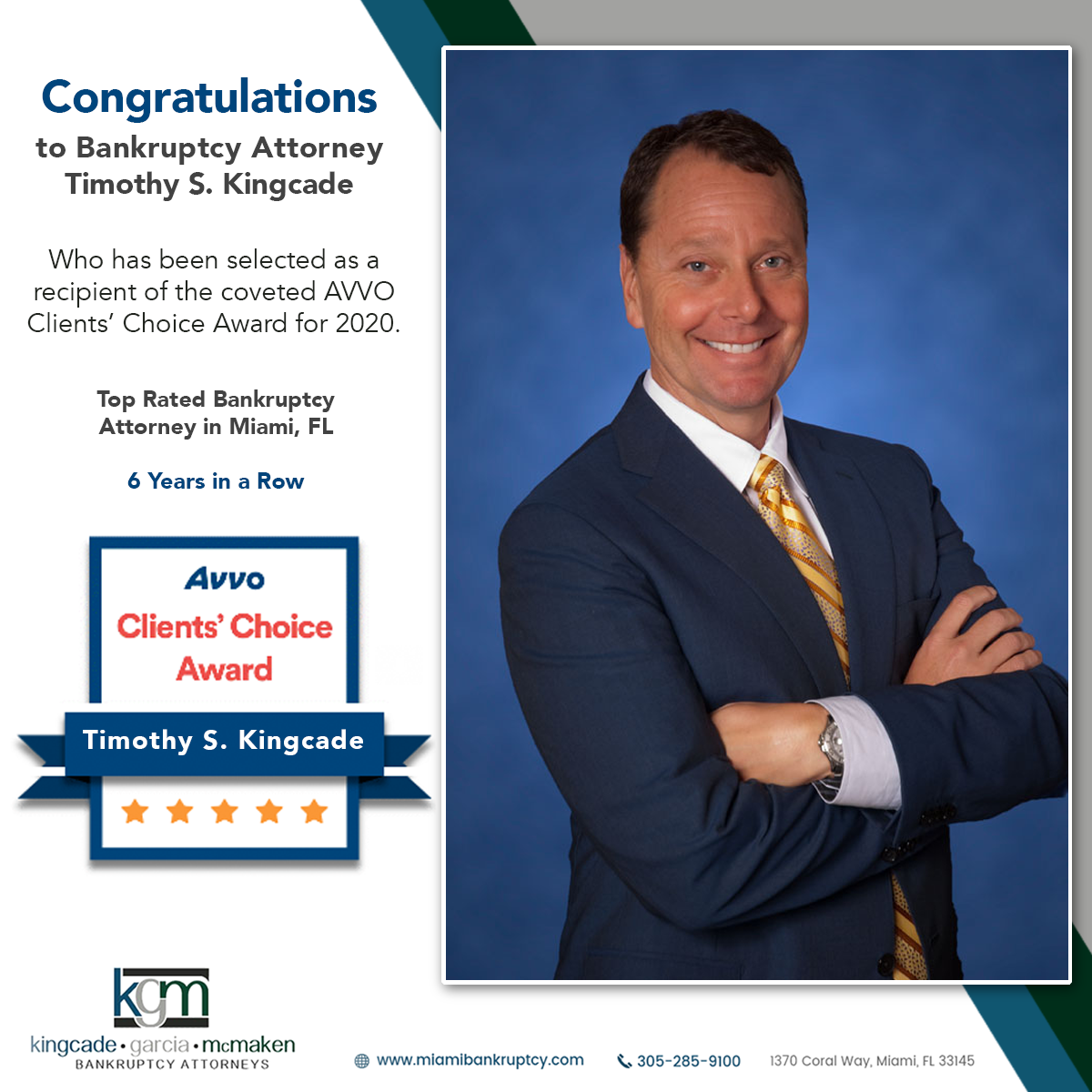
Miami Bankruptcy Attorney Timothy S. Kingcade Receives the Prestigious AVVO Clients’ Choice Award for 2020

MIAMI – (January 16, 2019) Managing Shareholder, Timothy S. Kingcade of the Miami-based bankruptcy law firm of Kingcade Garcia McMaken has received the 2020 AVVO Clients’ Choice Award. To obtain this award, an attorney must receive five or more exceptional client reviews in the same year.  This is the sixth consecutive year Kingcade has been honored with this award.
One of attorney Kingcade’s clients had this to say on AVVO: Mr. Timothy Kingcade is not only a living encyclopedia in matters of bankruptcy law, but he cares for you on a personal level. He was very detailed in explaining every step of the way what I had to expect as we entered this legal process and made me feel like family, and the rest of the team were always there to support me whenever I needed help. I definitely recommend his law firm; believe me they are the best!!!

Bankruptcy Law

The Most Common Forms of Bankruptcy Fraud

Bankruptcy laws require that the filer be honest and open about his or her financial situation, including disclosing all assets and debts. While no one wants to lose property to pay off creditors, some assets must be sold during the bankruptcy case to pay off the filer’s debts. If a filer actively tries to hide or fails to disclose information in hopes of keeping it from the bankruptcy court, this is called bankruptcy fraud and it can cause your case to be dismissed.

Hiding Assets

Concealing assets is one of the more common forms of bankruptcy fraud. Approximately 70 percent of all cases where some type of fraud was reported involved concealment of assets. It can involve the person simply leaving a certain asset off the list of those reported to the bankruptcy trustee. It can also involve hiding the asset through a fraudulent transfer, including giving the asset to someone else to keep it during the duration of the bankruptcy case, with the intent that the person holding the asset will return it after the case concludes. If this type of fraud is discovered, the filer and the person holding the asset could be held liable for bankruptcy fraud.

Bankruptcy Law, Debt Relief

How Long Does Bankruptcy Stay on Your Credit Report?

One of the biggest concerns consumers have when it comes to filing for bankruptcy is how long will the bankruptcy remain on their credit report. While a bankruptcy does hurt a person’s credit score, the effect it has depends on several different factors. Ultimately, it depends on the type of bankruptcy being filed and the financial habits exercised by the consumer after the case is over.

Chapter 7

A Chapter 7 bankruptcy case will stay on a consumer’s credit report for ten years from the date of filing. A Chapter 7 bankruptcy case is also known has a liquidation bankruptcy. This form of bankruptcy is normally used by people who have defaulted on their financial obligations and fall below a certain income threshold.

In a Chapter 7 bankruptcy case, the bankruptcy trustee has the authority to liquidate the borrower’s nonexempt assets and use them to pay down qualifying debts. The remaining debts, which are mostly unsecured ones, are discharged. Chapter 7 forgives debts including credit card debts, medical bills and unsecured personal loans. Certain debts, including taxes, criminal fines, child support, spousal support, and student loans, are not discharged usually in a Chapter 7 case. Not all consumers can pursue a Chapter 7 case, however. They must first pass a means test to ensure that their income and asset-to-debt ratios satisfy the requirement to file for Chapter 7 bankruptcy.

A consumer’s credit score can drop by as much as 200 points after filing for Chapter 7 bankruptcy. However, the alternative can be much worse if bankruptcy is not filed and the consumers ends up with multiple defaults and collections on his or her record. By exercising good financial habits over time, a person’s credit score can certainly be rebuilt.

Bankruptcy Law

What are the Credit Counseling Requirements in Bankruptcy?

Whenever a person files for Chapter 7 or Chapter 13 bankruptcy, he or she must submit proof that a credit counseling course from a nonprofit credit counseling agency was successfully completed. The purpose of this course is to help the filer determine whether he or she can pay his or her debt outside of bankruptcy and provide proper financial guidance to prevent an additional bankruptcy filing in the future.

What Is Required?

According to the Federal Trade Commission (FTC), all bankruptcy filers must take an approved credit counseling course prior to filing. The U.S. Department of Justice’s U.S. Trustee Program keeps a list of approved programs if filers are not sure where to go. Proof of completing a program must be submitted before the bankruptcy case can proceed further. In fact, this proof must be submitted within 180 days prior to filing for bankruptcy. The filer will normally walk away from the credit counseling program with a repayment plan, if a plan is realistic, although nothing in the FTC rules requires the filer to follow that specific plan.

Bankruptcy Law

How Long Does the Bankruptcy Automatic Stay Remain in Effect?

One of the benefits of filing for bankruptcy is the automatic stay and the protections it offers filers who are facing a multitude of collection calls from their creditors. It can also protect a person from lawsuits, wage garnishment, repossession, and losing valuable property.  As soon as the bankruptcy petition is filed, the automatic stay goes into effect. After this point, creditors and debt collectors are legally barred from attempting to collect on any debt owed by the filer.

The automatic stay will remain in effect throughout the duration of the bankruptcy case from filing to discharge. However, certain factors can affect the automatic stay and how long it remains in effect.

Debt Relief, student loan debt, Student Loans, Timothy Kingcade Posts

Student Loan Debt Relief Scams to Watch Out For

Student loan debt is an issue for many Americans, and for a great number of them, the situation has become a desperate one. This fact could be why so many borrowers are falling prey to student loan debt relief scams.

It is estimated that the national total student loan debt is well over $1.5 trillion. The average student loan borrower in 2018 is carrying just shy of $30,000 in loan debt, according to Student Loan Hero. This figure only represents what the average undergraduate student owes. For a graduate or professional degree, the borrower may end up with student loan debt well into six figures. With this much debt, borrowers can be paying on their loans for decades, which is why many of them jump at the opportunity, when presented, to get some sort of relief on their debt.  The problem is these “relief opportunities” end up being more trouble than they are worth.

Bankruptcy Law, Credit Card Debt, Debt Relief

Bankruptcy Filings on the Rise Across the Country

The number of bankruptcy filings are on the rise across the country, signaling that Americans are struggling to keep up with their debt.  The majority of the bankruptcy filings are in larger cities, where personal incomes are oftentimes not enough to pay household bills and daily living expenses.

According to the American Bankruptcy Institute (ABI), U.S. bankruptcy filings jumped by three percent in July 2019 from July 2018. A total of 64,283 filings were reported for July 2019, which is up from the 62,241 reported in July 2018. If this trend continues, the number of bankruptcies filed this year is anticipated to hit 796,000, which is more than the 777,000 reported last year.

Bankruptcy Law, Debt Relief

How to Protect Your Home in Bankruptcy

When facing the possibility of filing for bankruptcy, whether it be Chapter 7 or Chapter 13, the thought of losing your home can be frightening. In fact, losing one’s home can be one of the biggest concerns holding someone back from filing for bankruptcy. The lawyers at Kingcade Garcia McMaken work hard to protect people from losing their assets in a bankruptcy case, including the filer’s home.

Automatic Stay

One of the first protections filers receive when proceeding with any type of bankruptcy case is the automatic stay. The automatic stay keeps creditors from continuing any collections actions, and it immediately goes into effect after the bankruptcy petition is filed.

Credit Card Debt, Debt Relief

25 Percent of Americans Going into Debt Paying for Daily Living Expenses

More Americans are struggling to pay for their daily expenses and are using credit cards to pay for basic necessities, according to a recent report by Experian. This reliance on credit cards to pay for necessary living expenses puts consumers even deeper into debt. In fact, the report showed that American consumers carry an average of $6,506 in credit card debt.

Approximately 23 percent of those surveyed said that they struggled with paying for their most basic necessities, including rent, food, and utilities, and had to pay for these expenses with their credit cards. Of those consumers surveyed, 12 percent of them reported paying for medical bills with their credit cards.

It has been reported that the middle-class cost of living is now 30 percent more expensive than it was 20 years ago. The costs for essentially everything has increased over the years. According to the Economic Hardship Reporting Project, the cost of tuition at public universities and housing prices have quadrupled between 1996 and 2016.

Not only has the cost of living increased, but the amount of money Americans have in savings has decreased remarkably. A majority of American consumers say they have less than $1,000 in savings. Additionally, 70 percent of them report that they would not be able to get by if their paycheck was delayed by a week, which has many financial experts concerned.

Not all Americans are using their credit cards to pay for daily expenses, however. Many say that their discretionary spending on non-essential items, including entertainment, travel, and clothing, has led to their credit card balances. It is reported that Americans spend an average of $483 a month on eating out, entertainment, and travel, according to Schwab’s 2019 Modern Wealth report.

The average credit card APR is at an all-time high of 17.73 percent, according to CreditCards.com, which makes paying off large credit card balances, very difficult. With an average balance of $6,354, consumers could potentially be paying on these cards for years, if not decades. In fact, if someone has a credit card balance at this national average with a credit card that charges the average APR, he or she could be paying the minimum payment on that card for over 17 years before it is paid off in full. This scenario only works if the consumer stops using the card and does not add any new charges to the outstanding balance.

People living in the Miami metro area, which includes both Fort Lauderdale and West Palm Beach, carry the second-highest credit card debt balances in the country.  As bankruptcy attorneys, we see credit card debt as one of the most common problems facing those with serious financial challenges.  It is not surprising with the high interest rates, unreasonable fees, harassing debt collection calls, penalties and never-ending minimum payments that do not even make a dent in your actual debt. We offer additional tips for eliminating credit card debt on our blog.

Click here to read more on this story.

If you have questions on this topic or are in financial crisis and considering filing for bankruptcy, contact an experienced Miami bankruptcy attorney who can advise you of all of your options. As an experienced CPA as well as a proven bankruptcy lawyer, Timothy Kingcade knows how to help clients take full advantage of the bankruptcy laws to protect their assets and get successful results. Since 1996 Kingcade Garcia McMaken has been helping people from all walks of life build a better tomorrow. Our attorneys’ help thousands of people every year take advantage of their rights under bankruptcy protection to restart, rebuild and recover. The day you hire our firm, we will contact your creditors to stop the harassment. You can also find useful consumer information on the Kingcade Garcia McMaken website at www.miamibankruptcy.com.