
Consumer Bankruptcy, Debt Relief

Debt Relief vs. Bankruptcy in 2025

Debt relief and bankruptcy can offer real financial help in a challenging economic environment- but there are a few things you should know about each option.

American households are struggling with debt like never before, as total credit card balances have soared past $1.21 trillion nationally. With credit card interest rates approaching record highs and the cost of living rising, many people have found themselves trapped in a cycle of making minimum payments.

Amid the financial pressure, people are exploring different options to regain control over their debt.

Debt relief programs, such as credit card settlement plans, are increasingly accessible, while bankruptcy remains an option for those facing overwhelming debt.

Each option has unique benefits, costs, and long-term implications.

Debt relief programs only address unsecured debt, like credit cards, personal loans, and medical bills. These type programs cannot help with secured debts, like a mortgage or car loan.
filing for bankruptcy

Bankruptcy, on the other hand, can wipe out certain unsecured debts entirely, and in some cases, provide options for addressing secured debt. Understanding exactly what you owe, and to whom is the first step in deciding which approach to choose.

Debt relief programs work best if you have a steady income that allows you to make monthly payments. If your earnings are inconsistent or barely cover your living expenses, these programs can prove challenging to sustain.

For those whose income will not support repayment, bankruptcy provides a better option. However, post-bankruptcy budgeting is essential to avoid falling back into debt.

Choosing between bankruptcy and debt relief is a personal decision influenced by your total debt, income, credit outlook, and long-term goals.

Debt relief can offer structured repayment and lower interest costs without the long-lasting credit hit of bankruptcy, but it requires discipline and consistent payments. Bankruptcy, however, can immediately wipe out your debt and provide you with a fresh financial start when debt becomes unmanageable.

As you weigh your options, it is important to review each one carefully, ideally with a financial counselor, certified debt specialist, or experienced bankruptcy attorney before deciding.

Click here to read more on this story.

If you have questions on this topic or are in a financial crisis and considering filing for bankruptcy, contact an experienced Miami bankruptcy attorney who can assist you and address all of your options. As an experienced CPA as well as a proven bankruptcy lawyer, Timothy Kingcade knows how to help clients take full advantage of the bankruptcy laws to protect their assets and get successful results. Since 1996 Kingcade Garcia McMaken has been helping people from all walks of life build a better tomorrow. Our attorneys help thousands of people every year take advantage of their rights under bankruptcy protection to restart, rebuild, and recover. The day you hire our firm; we will contact your creditors to stop the harassment. You can also find useful consumer information on the Kingcade Garcia McMaken website at www.miamibankruptcy.com.
Credit Card Debt, Debt Relief

Total Household Debt by Type

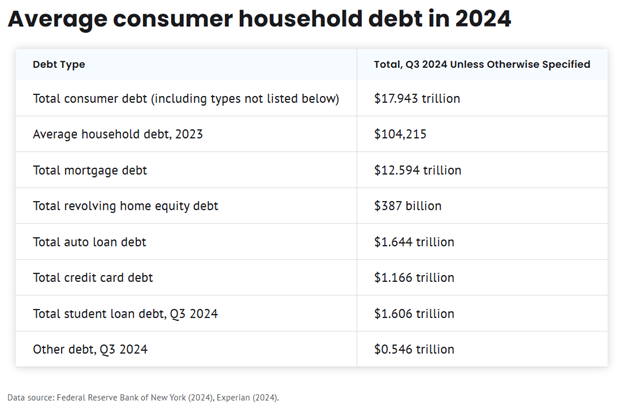
American household debt stands at a whopping $17.943 trillion dollars. Mortgage debt makes up 70% of that.  Inflation has contributed to more debt and the average debt rising in nearly every category compared to 2020. This includes total household debt, credit card debt, mortgage debt, and auto loan debt. Total debt is up by over $2.5 trillion since 2020.

Average consumer household debt in 2024

According to the latest Household Debt and Credit survey, Americans owe $1.166 trillion in credit card debt as of the third quarter of 2024. That’s a record high, up from $1.162 trillion in the second quarter. Americans had an average of $6,501 in in credit card debt in the third quarter of 2023, according to Experian.

Based on data from the second quarter in 2023, Gen X carries the highest average credit card balance, $8,870, while Gen Z carries the lowest average credit card balance, with $3,148.

Paying off debt and finding relief.

It may seem like you have too much debt to ever get out of. However, the first step is to address your debt.  Understand the total amount of debt you have. From there you can determine what type of debt you hold, like credit card debt, mortgage, or auto loan. Then it is important to note how much you owe, what the interest rate is, and what the minimum payment amount is for each type of debt you own.

As bankruptcy attorneys, we see credit card debt as one of the most common problems facing those with serious financial challenges.

Filing for bankruptcy is a viable option for those struggling with insurmountable credit card debt. Chapter 7 is the fastest form of consumer bankruptcy and forgives most unsecured debts like credit card debt, medical bills, and personal loans.

If you have questions on this topic or are in financial crisis and considering filing for bankruptcy, contact an experienced Miami bankruptcy attorney who can advise you of all of your options. As an experienced CPA as well as a proven bankruptcy lawyer, Timothy Kingcade knows how to help clients take full advantage of the bankruptcy laws to protect their assets and get successful results. Since 1996 Kingcade Garcia McMaken has been helping people from all walks of life build a better tomorrow. Our attorneys help thousands of people every year take advantage of their rights under bankruptcy protection to restart, rebuild and recover. The day you hire our firm; we will contact your creditors to stop the harassment. You can also find useful consumer information on the Kingcade Garcia McMaken website at www.miamibankruptcy.com.
SOURCE: Average American Household Debt in 2024: Facts and Figures

Bankruptcy Law, Credit, Debt Relief, Timothy Kingcade Posts

Higher Vehicle Costs Driving a Rise in Auto Loan Delinquencies

The price tags on vehicles continues to the increase, which means consumers are borrowing more money to make their purchases.  This in turn is having an effect on household budgets, pushing some families to the max.  New cars now cost an average $35,000, compared to an average $31,000 in 2013, according to Edmunds.com.

The monthly payment on a new vehicle with a $31,000 outstanding loan is about $516 a month, before insurance, gas and maintenance costs are factored in.

Used vehicles have also become more expensive.  The average loan on a used car bought at a dealership costs about $21,000 and carries an average $380-a-month payment.

Credit requirements have been less strict in recent years, as banks and other lending institutions began pushing auto loans, even sub-prime loans to meet the car-buying demand.

Delinquencies in indirect auto loans- those arranged through a third party, such as an auto dealer- increased to 1.83 percent.  Delinquencies in direct auto loans- those arranged directly through a bank- increased to 1.03 percent.

Consumers have over-extended themselves in other areas as well, according to the American Bankers Association.  Delinquencies in bank credit cards rose to 2.74 percent.  Home equity lines of credit delinquencies rose to 1.11 percent.

There certainly seems to be a correlation.  Consumers with credit card debt often struggle with auto loans and mortgage loans, too.

Just like with homes, consumers can end up with upside-down car loans, where the value of the car is worth less than what they owe. This is oftentimes due to higher interest and the terms and conditions of the loan itself.  Many consumers who end up trapped in these type loans are considered to be a higher credit risk.  They oftentimes end up being sold a lower-quality car at a higher cost.

When filing for Chapter 7 bankruptcy, consumers have some leverage because the lender knows that bankruptcy gives them the option of surrendering the vehicle and canceling all liability. Banks lose a lot of money on repossessions, so they have an incentive to offer a better deal, such as reducing the principal of the loan to the vehicle’s current value.

If you have any questions on this topic or are in financial crisis and considering filing for bankruptcy, contact an experienced Miami bankruptcy attorney who can advise you of all of your options. As an experienced CPA as well as a proven bankruptcy lawyer, Timothy Kingcade knows how to help clients take full advantage of the bankruptcy laws to protect their assets and get successful results. Since 1996 Kingcade & Garcia, P.A. has been helping people from all walks of life build a better tomorrow. Our attorneys’ help thousands of people every year take advantage of their rights under bankruptcy protection to restart, rebuild and recover. The day you hire our firm, we will contact your creditors to stop the harassment. You can also find useful consumer information on the Kingcade & Garcia website at www.miamibankruptcy.com.

Related Resources:

http://www.post-gazette.com/business/money/2017/07/10/Car-loans-delinquencies/stories/201707090086

http://www.nolo.com/legal-encyclopedia/car-chapter-7-bankruptcy-29608.html