Filing Bankruptcy

Why Filing for Bankruptcy Shouldn’t be a DIY Project

Filing for bankruptcy “pro se” means representing yourself without an attorney. The bankruptcy process involves complex rules, forms, laws, and court decisions, making self-representation risky. Some people choose this approach because they believe they cannot afford an attorney or their case is straightforward. Regardless of the reason, filing without legal guidance is not advisable.

Here are some of the most common problems with filing for bankruptcy pro se (without an attorney):

  • Filing the wrong type of bankruptcy – Each type of bankruptcy is designed to solve specific problems.  Property is treated very differently when it comes to Chapter 7 and Chapter 13.  If you file the wrong Chapter bankruptcy, you run the risk of losing valuable property or end up not being able to discharge certain debts.
  • Losing valuable property that could have been protected — Personal bankruptcy allows you to claim exemptions that can protect your home and even your business. In a Florida Chapter 7 case, state bankruptcy exemptions can help safeguard your property. Florida’s homestead exemption is among the most generous in the country. To use Florida’s exemptions, you must have lived in the state for at least 730 days before filing your bankruptcy petition. Learn more about common Florida bankruptcy exemptions.
  • Filling out the bankruptcy forms incorrectly — Your bankruptcy petition must be accompanied by documents listing all debts, creditors, and assets. Errors or omissions can cause delays, additional costs, or dismissal of your case.
  • Experiencing continued creditor harassment – When you hire an attorney to file your bankruptcy, creditors are required by law to only speak with your attorney and may no longer harass you about your debt.  If you choose to represent yourself in bankruptcy, the lender may try and lift the automatic stay, which is what protects you from continued creditor calls while your bankruptcy is ongoing.   A consumer has specific rights when a creditor violates the automatic stay.
  • Missing required education courses — Chapter 7 and Chapter 13 filers must complete approved credit counseling before filing and a financial management course before receiving a discharge. These requirements can confuse pro se filers. Failure to file the required certificate can result in dismissal of the case.

Understanding these issues is important if a creditor challenges whether a debt can be discharged, the trustee alleges fraud, or another legal dispute arises. An attorney’s guidance is essential to successfully responding to a complaint or motion.

If you have any questions on this topic or are in financial crisis and considering filing for bankruptcy, contact an experienced Miami bankruptcy attorney who can advise you of all of your options. As an experienced CPA as well as a proven bankruptcy lawyer, Timothy Kingcade knows how to help clients take full advantage of the bankruptcy laws to protect their assets and get successful results. Since 1996 Kingcade Garcia McMaken has been helping people from all walks of life build a better tomorrow. Our attorneys’ help thousands of people every year take advantage of their rights under bankruptcy protection to restart, rebuild and recover. The day you hire our firm, we will contact your creditors to stop the harassment. You can also find useful consumer information on the Kingcade Garcia McMaken website at www.miamibankruptcy.com.

Related Resources:

O’Niell, Cara. “Filing for Bankruptcy Without an Attorney.” NOLO, 27 August, 2026.  https://www.nolo.com/legal-encyclopedia/pitfalls-filing-chapter-7-bankruptcy-without-attorney.html

Consumer Debt

U.S. Wealth and Income Are Up, But It Depends Who You Ask

According to the Federal Reserve’s Survey of Consumer Finances, American families’ median net worth increased just 2% from 2022 to 2025, reaching $215,900. Families with less wealth at the outset saw declines, while wealthier families recorded larger gains, reinforcing existing wealth disparities. Richer households saw most of the wealth growth, while many lower-income families struggled financially and faced mounting credit card debt. Wealthy households also benefited from sizable gains in equity values.

Key Takeaways:

  • The Federal Reserve’s Survey of Consumer Finances shows median net worth for American families rose only 2% from 2022 to 2025, reaching $215,900.
  • Median household income increased 7% over the same period, reaching $82,200.
  • From 2022 to 2025, the median net worth of the bottom fourth of households fell from $3,800 to $1,700, a decline of more than 50%.
  • Median net worth among the wealthiest 10% of families increased about 19%, from $4.15 million to $4.94 million.
  • Between 2022 and 2025, the share of families with overdue loan payments rose from 12% to 20%, while the share at least two months behind increased from 5% to more than 8%.

Americans face difficulty making debt payments.

From 2022 to 2025, the share of American families in debt remained about the same at 77%, but fewer were able to make payments on time. Families were more likely to be struggling financially than at any other point since 2010, the Fed said. From 2022 to 2025, the portion of families that reported being behind on loan payments increased from 12% to 20%, and more than 8% said they were two or more months behind, up from 5% three years prior.

While each consumer’s financial situation is different, there are ways to determine if you are carrying too much credit card debt.

Consider your answers to the following questions:

  • Is credit card debt affecting your financial and emotional well-being? High credit card balances can lower your credit score and create financial strain and emotional stress. As a general guideline, keep your monthly credit card payments at or below 10 percent of your monthly income.
  • Are you paying only the minimum? Credit cards typically have low monthly minimum payments, but that doesn’t mean they are affordable just because you can cover that amount. If you are only able to make the minimum payment, that can be a sign you have too much credit card debt.
  • Is your credit card debt impacting your credit score? Credit cards can help your credit score- or hurt it, depending on how you use them. It is recommended that you keep your credit utilization below 30 percent. Having significant credit card debt can have a negative impact on your credit score. This can make other debts, like your mortgage and car payments more expensive.

As bankruptcy attorneys, we see credit card debt as one of the most common problems facing those with serious financial challenges.

Bankruptcy can offer relief to people overwhelmed by credit card debt. Chapter 7 is the quickest form of consumer bankruptcy and eliminates most unsecured debts, including credit card balances, medical bills, and personal loans. To qualify, consumers must meet requirements related to income, assets, and expenses, assessed through the bankruptcy means test.

Click here to read more on this story.

If you have questions on this topic or are in a financial crisis and considering filing for bankruptcy, contact an experienced Miami bankruptcy attorney who can assist you and address all your options. As an experienced CPA as well as a proven bankruptcy lawyer, Timothy Kingcade knows how to help clients take full advantage of the bankruptcy laws to protect their assets and get successful results. Since 1996 Kingcade Garcia McMaken has been helping people from all walks of life build a better tomorrow. Our attorneys help thousands of people every year take advantage of their rights under bankruptcy protection to restart, rebuild, and recover. The day you hire our firm; we will contact your creditors to stop the harassment. You can also find useful consumer information on the Kingcade Garcia McMaken website at www.miamibankruptcy.com.

Filing Bankruptcy, Life After Bankruptcy, Rebuilding Credit

What Happens After Bankruptcy?

After filing for bankruptcy, you will likely have questions about how it will affect your credit and what steps you can take to move forward.

What can I expect the first year after filing bankruptcy?

A bankruptcy discharge releases you from personal liability for qualifying debts. In Chapter 7, you can be free and clear of your debts within a few months after filing; in Chapter 13, it generally comes after you complete the repayment plan.

Prioritizing your financial stability should be a top priority one year after filing. Avoid taking on any new debt. Many people receive credit card offers in the mail soon after filing bankruptcy. And while it can be tempting, it’s best to avoid these offers. Instead, focus on managing your monthly expenses, building an emergency fund, and reducing any major expenses.

A reason people hold off on filing bankruptcy is the fear of what it will do to their credit and financial future. While filing for bankruptcy will impact a person’s credit score, this damage is not irreparable.

After bankruptcy, you can begin taking steps right away to improve your credit history.

  1. Pull a copy of your credit reports for free by visiting https://www.annualcreditreport.com/.
  2. Make sure your credit reports are accurate. The accounts that were discharged in bankruptcy should be closed. If any discrepancies are found, these errors should be reported right away to the credit bureaus via a formal dispute.
  3. Prioritize making future payments on time. It sounds simple, but on-time payments and responsible credit card use can significantly help you recover from bankruptcy.
  4. Open a new line of credit. After some time has passed and you feel financially stable, consider opening a new line of credit with a reputable lender to reestablish healthy credit habits.
  5. Creating a budget is important after completing a bankruptcy case. Write down all necessary living expenses and track how much of the consumer’s income can be used to go towards paying these costs. A good rule of thumb when budgeting is to follow the 50/30/20 rule. What this entails is 50 percent of the consumer’s income goes towards meeting his or her needs. Another 30 percent would be set aside for items that are considered not necessary or are wanted, while 20 percent of the monthly income goes towards savings.

Click here to read more.

Facing financial hardship and considering bankruptcy? An experienced Miami bankruptcy attorney can guide you through the process. Timothy Kingcade combines his experience as a CPA and bankruptcy lawyer to help clients protect their assets and achieve successful results under bankruptcy law. Since 1996, Kingcade Garcia McMaken, P.A., has helped people from all walks of life build a brighter future. Each year, our firm helps thousands of people use bankruptcy protection to restart, rebuild, and recover. We contact your creditors the day you hire us to stop the harassment. Find more consumer information at www.miamibankruptcy.com.

Bankruptcy Costs, Chapter 13, Chapter 7

How Much Does It Cost to File Bankruptcy in Florida?

Bankruptcy filing costs depend largely on whether you file under Chapter 7 or Chapter 13 and whether you hire an attorney.

Some people choose to represent themselves because they believe they cannot afford an attorney.

Filing for bankruptcy pro se can be risky because the process involves complex rules, forms, statutes, and court decisions.   Most people end up hiring aan attorney to navigate the legal process.

Attorney Fees

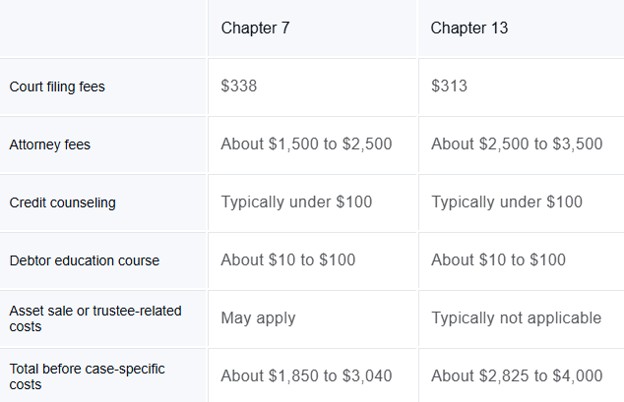
While some attorneys charge a flat rate for bankruptcy services, others charge an hourly rate. In general, Chapter 7 filers pay about $1,500 to $2,500 in attorney fees upfront, while Chapter 13 filers often pay about $2,500 to $3,500, with higher costs possible depending on location and case complexity. Chapter 13 fees are usually built into your monthly debt repayment plan.

If your case involves a business, significant property, disputed debts, or other complications, it may require more attorney time and result in higher fees. Chapter 13 cases cost more because they require attorneys to develop a repayment plan and often involve additional work over the course of the case.

While these costs are high, hiring an attorney ensures that your dischargeable debts are managed correctly.

Chapter 7 vs. Chapter 13 filing fees

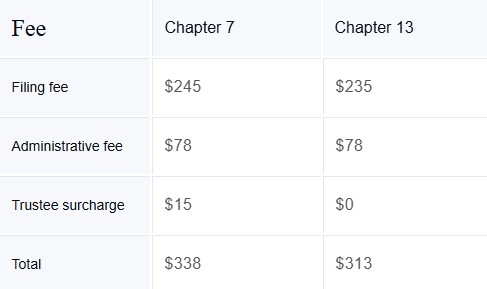
The cost of bankruptcy includes separate court and attorney fees. At a minimum, every filer must pay court filing fees directly to the bankruptcy court, along with credit counseling costs.

The basic court fees for Chapter 7 and Chapter 13 break down as follows:

Additional Court Fees

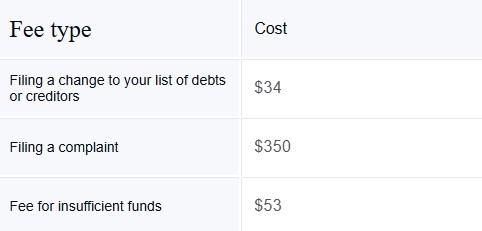
The U.S. Courts may charge for specific services throughout your case. The following table outlines common administrative fees accurately as of publication but note that this list is not exhaustive of every fee you might encounter.

Chapter 7 filers who meet income requirements and cannot afford installments may ask the court to waive the filing fee. This option is available to those earning less than 150% of the federal poverty level. Chapter 13 fees cannot be waived, but eligible filers may request an installment plan.

Basic filing fees may not cover all court-related expenses. Additional services and actions during a bankruptcy case can add to the total cost.

Additional costs of filing for bankruptcy

In addition to court and attorney fees, bankruptcy may involve smaller required or case-specific expenses. Although these costs are usually modest, they can still strain an already tight budget:

  • Credit counseling fees: You are typically required to attend at least one credit counseling session before filing. You can work with a credit counselor or take an online class, and classes usually cost under $100. The U.S. Department of Justice maintains a list of approved agencies you can use.
  • Debt education course: After filing, you must complete a financial management Depending on the provider, it can cost $10 to $100.

Click here to read more.

If you have questions on this topic or are in a financial crisis and considering filing for bankruptcy, contact an experienced Miami bankruptcy attorney who can assist you and address all your options. As an experienced CPA as well as a proven bankruptcy lawyer, Timothy Kingcade knows how to help clients take full advantage of the bankruptcy laws to protect their assets and get successful results. Since 1996 Kingcade Garcia McMaken has been helping people from all walks of life build a better tomorrow. Our attorneys help thousands of people every year take advantage of their rights under bankruptcy protection to restart, rebuild, and recover. The day you hire our firm; we will contact your creditors to stop the harassment. You can also find useful consumer information on the Kingcade Garcia McMaken website at www.miamibankruptcy.com.

Consumer Debt, Credit Score, Debt Collection, Payday Loans

What Happens If I Can’t Payback a Payday Loan?

Many people use payday loans to cover expenses, like utilities, gas, and groceries, when they run out of money before their next paycheck. But because of the loan’s high cost and short turn around time, it can be difficult to pay them back on time.

Defaulting on a payday loan can result in fees, collection calls, even legal action being taken against you. Lenders may send your unpaid account to a collection agency, which can end up damaging your credit score if it appears on your credit report.

Understanding what happens if you cannot pay back a payday loan and the options available can help you decide how to handle your loan.

Consequences of Not Paying Back a Payday Loan

  • Fees and Interest Accumulation

Payday loans come with high fees that equate to triple-digit annual percentage rates (APRs). If you fail to repay the loan on time, late fees and interest can accumulate, making it increasingly difficult to pay back the original loan.

  • Bank Fees

Payday lenders usually require access to an active checking or debit account so they can deposit funds and collect repayment by electronic debit or post-dated check. If your account lacks enough money when payment is due, you may face overdraft or insufficient funds fees. Repeated withdrawal attempts can add more fees and worsen your financial hardship.

  • Debt Collection

After several unsuccessful attempts to collect payment, payday lenders may sell your debt to a collection agency. Collection agencies often use aggressive tactics to recover the debt including frequent phone calls, letters and even emails or text messages.

  • Impact on Your Credit Score and Future Credit

Payday lenders typically do not report payments to the credit bureaus. However, if you stop paying and the debt is sent to collections, it can hurt your credit score and make it harder to qualify for new credit cards, loans, or other services that require a credit check.

  • Legal Consequences

In some cases, lenders or collection agencies may pursue legal action to collect the debt. This can lead to a judgment against you, which can result in wage garnishment or bank account levy.

What to Do if You Cannot Repay a Payday Loan

  • Request a financial hardship program. Reach out to your lender before the due date to ask for an extension or repayment plan.
  • Stop electronic withdrawals. To prevent bank fees, you can revoke the lender’s payment authorization. Notify the lender in writing and inform your bank.
  • Borrow from a trusted friend or family member. If feasible, consider borrowing from a trusted friend or family member, to help pay off your payday loan debt. Be sure to establish a clear repayment plan to maintain your relationship.
  • Seek credit counseling. A nonprofit credit counselor may be able to help you find solutions for getting out of your payday loan debt.
  • Avoid taking out another payday loan. While it may be tempting to borrow a second loan to cover the first, doing so can trap you in a cycle of payday loan debt.

How to Rebuild Credit After Payday Loan Default

  • Get current on your payments. If you still have outstanding payday loan, prioritize paying them off. You may be able to negotiate a lower payoff amount, even if the loan has gone to collections.
  • Pay down existing debt. Work on reducing your credit card balances. A lower credit utilization ratio can have a positive impact on your credit score.
  • Monitor your credit. Check your credit report for any inaccuracies. Dispute any errors with the three major credit bureaus (Equifax, Experian, and TransUnion). If you find inaccuracies on your credit report, you have the right to file a dispute with the credit bureaus to have them corrected or removed.
  • Make on-time payments. Payment history accounts for a significant portion of your credit score. Making consistent, on-time payments toward your bills and credit cards can have a positive impact on your credit score.
  • Lower your credit utilization. Pay down revolving credit accounts to free up more available credit. The goal is to keep your credit utilization at 30% or lower. Your debt payment history is the most important factor in your credit score calculation, making up 35% of your FICO®ScoreΘ. This score is used by 90% of top lenders.
  • Avoid taking on additional debt. Limit new credit applications while rebuilding your credit. Applying for multiple accounts at once can add hard inquiries to your credit report and may temporarily lower your score. Space out applications and apply only when necessary.
  • Build positive credit. Make on-time payments on bills and credit accounts to help improve your score. You might also build credit with a secured credit card or by becoming an authorized user on the account of someone who manages credit responsibly.

If you have questions on this topic or are in a financial crisis and considering filing for bankruptcy, contact an experienced Miami bankruptcy attorney who can assist you and address all your options. As an experienced CPA as well as a proven bankruptcy lawyer, Timothy Kingcade knows how to help clients take full advantage of the bankruptcy laws to protect their assets and get successful results. Since 1996 Kingcade Garcia McMaken has been helping people from all walks of life build a better tomorrow. Our attorneys help thousands of people every year take advantage of their rights under bankruptcy protection to restart, rebuild, and recover. The day you hire our firm; we will contact your creditors to stop the harassment. You can also find useful consumer information on the Kingcade Garcia McMaken website at www.miamibankruptcy.com.

SOURCES:

Dow, N. (2026, March 4) Can’t Repay a Payday Loan? Here’s What to Do. Nerdwallet. Nerdwallet.com.

Irby, L. (2024, October 7) What Happens if You Can’t Pay Back a Payday Loan? Experian. Experian.com

Bankruptcy Filings

Why More Americans Are Going Bankrupt and What It Means

If you are struggling with overwhelming debt and are thinking of filing for bankruptcy, you’re not alone. While the word “bankruptcy” often conjures up images of failed companies, personal bankruptcies are far more common. More than half a million personal bankruptcies were filed last year, a nearly 50% jump from three years earlier, according to the Administrative Office of the U.S. Courts.

Filings at the end of March were up almost 12% from a year earlier.

Experts say this shows that a growing number of Americans have reached the point where the pressure of their debt has surpassed the stigma of bankruptcy.

A common bankruptcy concern is that it can hurt your credit history. But if you’re filing for bankruptcy, your credit score is probably not in the best place.

In fact, many of our clients have seen their credit scores improve after filing for bankruptcy. Here’s what some of them have to say.

All three of my credit reports showed a score of 775. I couldn’t believe my score was that high after 10 years. Working with Tim was the best decision I made for my situation. I have no regrets, and I’m glad to have the past behind me. – Bill T.

Hi Tim, I wanted to send a quick note to thank you and your team for handling my bankruptcy case. Just a month or two after discharge, my credit scores are already in the upper 600s. I’ve included a screenshot in case you would like to use it with prospective clients. – C.S.

While filing for bankruptcy can relieve you from your debts, it is not a step to be taken lightly. Be sure to ask yourself the following questions before filing for bankruptcy.

  • Have I exhausted all my options? Thoroughly investigate alternatives or consider selling assets to pay off your debts. Alternatives, such as loan modifications and credit counseling, may provide a way to manage your debt and avoid some of the costs of filing for bankruptcy.
  • What type of bankruptcy is most appropriate for my situation? There are different types of bankruptcy. For individuals, the options are Chapter 7 and Chapter 13 bankruptcy. Chapter 7 involves liquidating your assets to pay off debts, while Chapter 13 establishes a repayment plan over a three-to-five-year period. Each has its own eligibility requirements, so understanding which type you qualify for is key.
  • How will bankruptcy affect my credit score and for how long? Bankruptcy will have an impact on your credit score, potentially lowering it by 200 points or more. However, if your score is already low, perhaps due to high credit card balances or late payments, it may not drop that many points.
  • Can I afford the costs associated with filing for bankruptcy? While it may seem counterintuitive, filing for bankruptcy isn’t free. It is a legal process that comes with costs. There are court filing fees and it is important to hire an experienced bankruptcy attorney to help you navigate the process.
  • Will bankruptcy discharge all my debts? Not all debts can be discharged in bankruptcy. For example, federal student loans, most tax debt, alimony and child support payments cannot be discharged in bankruptcy.

Click here to read more.

If you have questions on this topic or are in a financial crisis and considering filing for bankruptcy, contact an experienced Miami bankruptcy attorney who can assist you and address all your options. As an experienced CPA as well as a proven bankruptcy lawyer, Timothy Kingcade knows how to help clients take full advantage of the bankruptcy laws to protect their assets and get successful results. Since 1996 Kingcade Garcia McMaken has been helping people from all walks of life build a better tomorrow. Our attorneys help thousands of people every year take advantage of their rights under bankruptcy protection to restart, rebuild, and recover. The day you hire our firm; we will contact your creditors to stop the harassment. You can also find useful consumer information on the Kingcade Garcia McMaken website at www.miamibankruptcy.com.

Consumer Debt, Predatory Loans

5 Loans You Should Never Get

Certain loans can help you reach your financial goals. However, loans with high interest rates and fees, or payment terms that trap borrowers in a cycle of debt can create long-term problems. These are often referred to as predatory loans. These loans come with high annual percentage rates (APRs), short repayment terms, and balloon payments or hidden penalties. They are aggressively marketed to people with bad credit. Understanding the risks of these loans can help you make better borrowing decisions and protect your credit and financial future.

Here are five types of loans you should avoid entirely, or approach with caution.

  1. Payday Loans. These short-term, high-cost loans are usually meant to be repaid by your next paycheck. They promise fast approval with no credit check, making them appeal to people facing urgent financial stress. Beware, these loans come with sky-high interest rates and fees. Many payday lenders charge APRs that exceed 400% and the repayment window is often only two weeks.
  2. Car Title Loans. These loans are another form of short-term lending, where you use your car title as collateral. If you do not repay the loan on time, the lender can repossess your car. This can be risky if you rely on your vehicle for work, handle daily tasks, or care for your family.
  3. Cash Advances from Credit Cards. This allows you to withdraw money from your credit card account. It’s one of the most expensive ways to borrow money. Cash advances carry higher interest rates and start accruing interest immediately.
  4. High Interest Installment Loans. These loans are more manageable than payday loans because they allow repayment over time. But many of these loans come with high interest rates and fees that make them just as risky. These loans often target people with poor credit who may not qualify for bank loans or low interest credit cards.
  5. Loan Offers with No Credit Check. While these loans may sound appealing, their terms and conditions are not. These loans are often marketed to people with poor credit. Lenders are not worried about you repaying the loan because they are making their money off the interest and sky-high fees.

Click here to read more on this story.

If you have questions on this topic or are in a financial crisis and considering filing for bankruptcy, contact an experienced Miami bankruptcy attorney who can assist you and address all your options. As an experienced CPA as well as a proven bankruptcy lawyer, Timothy Kingcade knows how to help clients take full advantage of the bankruptcy laws to protect their assets and get successful results. Since 1996 Kingcade Garcia McMaken has been helping people from all walks of life build a better tomorrow. Our attorneys help thousands of people every year take advantage of their rights under bankruptcy protection to restart, rebuild, and recover. The day you hire our firm; we will contact your creditors to stop the harassment. You can also find useful consumer information on the Kingcade Garcia McMaken website at www.miamibankruptcy.com.

Medical Debt

How to Lower Your Medical Debt and Avoid Damaging Your Credit

Like other types of debt, unpaid medical bills can stay on your credit report for up to seven years. It can affect your ability to take out loans, finance a home or car, and qualify for credit.

If you can resolve medical debt quickly or keep it below $500, it may never show up on your credit report. Paid medical debt, medical debts under $500, and unpaid debts less than one year old are no longer reported by the three major credit bureaus.

Here are some ways to get rid of medical debt.

  • Review your bill carefully. Request an itemized bill and check for errors. Make sure the charges are accurate, that you were not billed twice, and your insurance benefits were applied.
  • Request a payment plan. Hospitals and doctors’ offices often offer payment plans and may work with you to set an affordable monthly amount. These plans are often interest-free and can help keep your account out of
  • Negotiate the bill. Hospitals will sometimes allow you to negotiate a lower balance. This can apply when you either pay in full or within a certain period.
  • Explore financial assistance options. Some hospitals offer financial assistance programs that can significantly discount or entirely waive medical bills for qualifying patients. You may qualify for reduced or free care based on your household income, especially if you are uninsured or underinsured. These policies usually apply to medically necessary care, with eligibility determined on a sliding scale based on the Federal Poverty Level.

Here’s what to do if your medical debt is already in collections.

  • Confirm the debt is valid. You have the right to request a debt validation letter from the collection agency. Review it to confirm the amount is correct and that your insurance was If the agency cannot verify the debt, you can dispute it with the credit bureaus.
  • Check if the debt will be recorded. Medical debt under $500, or less than a year old, should not appear on your credit reports. If they do, you can file a dispute with the credit bureaus to have it removed.
  • Reduce the balance. Even if you cannot pay the full amount, lowering the debt below $500 may help remove it from your credit report. Once you pay it down, ask the collection agency to update your credit report.

How Bankruptcy Treats Medical Debt

In bankruptcy, medical debt is treated the same as credit card debt. Medical bills are listed as general unsecured debt and can be easily wiped out in a Chapter 7 bankruptcy filing. Making the decision to file for bankruptcy is never an easy one.

Fortunately, consumers have the option available to them to file for bankruptcy to escape this burden of medical debt. In a bankruptcy case, debts are classified into two categories: secured and unsecured, as well as priority and nonpriority debts. Secured debts are those that are backed by a form of collateral, while priority debts can be unsecured but receive special status, such as tax bills, student loans, and child support. Unsecured debts are those debts that are not secured by collateral and include personal loans, credit card debt, and medical debt.

In a bankruptcy case, unsecured debts are the ones that are discharged at the end of the case, while priority and secured debts are the focus of payment plans or payment in a Chapter 7 case after assets are liquidated. If a debt is discharged, this means the court has issued an order stating that the debt does not have to be paid.

Medical debt may also become part of the repayment plan issued as part of a Chapter 13 bankruptcy case. The bills may not end up paid in full, but the medical providers will receive at least some amount of payment, which helps the consumer maintain a relationship with their healthcare providers. Repayment plans normally last three to five years, ending with the consumer’s remaining debts, including medical debt, getting discharged.

Click here to learn more.

Those who have experienced illness or injury and found themselves overwhelmed with medical debt should contact an experienced Miami bankruptcy attorney. In bankruptcy, medical bills are considered general unsecured debts just like credit cards. This means that medical bills do not receive priority treatment and can easily be discharged in bankruptcy. Bankruptcy laws were created to help people resolve overwhelming debt and gain a fresh financial start. Bankruptcy attorney Timothy Kingcade knows how to help clients take full advantage of bankruptcy laws to protect their assets and get successful results. Since 1996 Kingcade Garcia McMaken, P.A., has been helping people from all walks of life build a better tomorrow. Our attorneys help thousands of people every year take advantage of their rights under bankruptcy protection to restart, rebuild, and recover. The day you hire our firm; we will contact your creditors to stop the harassment. You can also find useful consumer information on the Kingcade Garcia McMaken, P.A. website at www.miamibankruptcy.com.

Chapter 13 Bankruptcy

Pros & Cons of Filing Chapter 13 Bankruptcy in Florida

Bankruptcy filings have been on the rise in Miami. Inquiries have increased due to the cost of living, elevated interest rates, and consumer debt. Inflation, healthcare, housing, and the cost of energy are some of the issues people cite as their top financial concerns.

Chapter 13 bankruptcy, referred to as a “wage earner’s plan” or a “reorganization bankruptcy,” has become a common choice for people who need time to catch up on their debts.

There are advantages to filing Chapter 13 bankruptcy in Miami, and a few drawbacks. It’s important to discuss your personal circumstances with an experienced Miami bankruptcy attorney to understand how bankruptcy will affect you.

How Chapter 13 Bankruptcy Works
When you file for Chapter 13 bankruptcy, you will submit a detailed budget showing your monthly income and expenses. The bankruptcy court uses this information to determine how much you can realistically afford to pay your creditors each month. Allowed expenses include housing, utilities, food, transportation, insurance, medical care, and other necessary costs. The court follows standardized guidelines for many of these expenses, but there’s flexibility based on a filer’s specific circumstances.

The remaining amount becomes your monthly Chapter 13 payment. This means you keep enough of your income to maintain a basic standard of living while repaying what you can afford with your creditors.

Pros:
*End Creditor Harassment. Thanks to the automatic stay, creditors will no longer be able to contact you.

*Avoid Foreclosure. If you have fallen behind on your mortgage payments, filing Chapter 13 can help you keep your home by getting caught up on those payments.

*A Defined Repayment Plan. Allows you to pay what you can according to your income and assets.

Cons:
*Expect your credit score to take a hit. However, it’s important to remember, continuing to struggle with your debt will also have a negative impact- not only on your credit score, but on your health and your happiness. Balances eventually become too high and overdue payments and delinquencies result.

*Not being able to wipe out all your debt. Unlike Chapter 7 bankruptcy, you do not discharge all your debt. You repay it. Chapter 13 plans can last anywhere from three to five years, but most are five-year plans.

It is worth noting that in Chapter 13 bankruptcy not everyone pays back the same percentage of their debt. Some people repay their unsecured creditors in full, while others might pay back only a fraction, sometimes as little as 10% or even less, depending on their disposable income and the value of their assets. The point here is that your payment is based on what you can afford, not on taking everything you earn.

If you have any questions on this topic or are in financial crisis and considering filing for bankruptcy, contact an experienced Miami bankruptcy attorney who can advise you of all your options. As an experienced CPA as well as a proven bankruptcy lawyer, Timothy Kingcade knows how to help clients take full advantage of the bankruptcy laws to protect their assets and get successful results. Since 1996 Kingcade Garcia McMaken has been helping people from all walks of life build a better tomorrow. Our attorneys help thousands of people every year take advantage of their rights under bankruptcy protection to restart, rebuild, and recover. The day you hire our firm; we will contact your creditors to stop the harassment. You can also find useful consumer information on the Kingcade Garcia McMaken website at www.miamibankruptcy.com.

Bankruptcy Law, Legal Awards

Timothy S. Kingcade Receives AV Rating and Client Champion Platinum Award

Bankruptcy Attorney Timothy S. Kingcade Receives the Preeminent AV Rating & Client Champion Platinum Award from Martindale-Hubbell for 2026

                                    Preeminent AV Rating                    Client Champion Platinum Award

MIAMI (February 18, 2026)– Managing Shareholder, Timothy S. Kingcade of Kingcade Garcia McMaken has received the preeminent AV rating for 2026 from Martindale-Hubbell, joining a select group of lawyers recognized for their legal ability and professional ethical standards. In addition, he has earned the 2026 Client Champion Platinum Award.

The Client Champion Platinum Award from Martindale-Hubbell is the highest client-focused recognition, given to attorneys who have earned at least 10 verified client reviews with an average score of 4.5 or higher (out of 5.0), demonstrating exceptional client service and satisfaction, and is presented alongside the peer-rated AV Preeminent rating for overall excellence.

“I am honored to have received the preeminent AV rating and Client Champion Platinum Award from Martindale-Hubbell,” said Timothy S. Kingcade. “This is a testament to the commitment that I make to each one of our clients and the ethical standards we uphold as a law firm. It is gratifying to know that my colleagues respect and acknowledge my legal abilities and the continued dedication to our clients and the profession.”

The Martindale-Hubbell AV rating designates the highest level of professional excellence and ethical standards an attorney can receive. This rating establishes that an attorney’s colleagues and judiciary perceive him to be at the pinnacle of professional success.

Martindale-Hubbell Peer Review Ratings are an objective indicator of a lawyer’s ethical standards and professional ability, derived from evaluations of lawyers by members of the bar and the United States judiciary. The Legal Ability ratings are based on performance in five key areas, which include: Legal knowledge, analytical capabilities, judgment, communication ability, and legal experience.

Attorney Timothy S. Kingcade practices exclusively in the field of bankruptcy law, handling Chapter 7 filings, and foreclosure defense cases for the Southern District of Florida. As an experienced CPA as well as a proven bankruptcy attorney, Timothy Kingcade knows how to help clients take full advantage of the bankruptcy laws, which protect them and achieve desired results.

###

Miami-based Kingcade Garcia McMaken, P.A. was established by managing partner and bankruptcy attorney, Timothy S. Kingcade in 1996. The firm represents clients throughout the State of Florida in Chapter 7 bankruptcy and foreclosure defense cases. The firm is committed to providing personalized service to each and every client, clearly explaining the options according to the unique circumstances of his or her life. The office environment and the service provided are centered on a culture of superior client care for the financially disenfranchised. All partners and associates at Kingcade Garcia McMaken P.A. specialize in consumer bankruptcy and foreclosure and have dedicated their practices to this area of the law. Additionally, all attorneys and staff members at the firm are bilingual speaking Spanish. For more information, visit https://www.miamibankruptcy.com/ or call (305) 285-9100.