
Bankruptcy Law, Filing Bankruptcy

Bankruptcy Checklist: The Financial Documents Needed to File Bankruptcy in Florida

At the start of a bankruptcy case, the filer is asked to fill out certain forms, including disclosures regarding their financial affairs. This disclosure includes the person’s income, expenses, assets, debts, and any property transfers.

The filer will also need to provide supporting documentation. The documents required are similar for Chapter 7 and Chapter 13 cases, with slightly different variations. It is often helpful to check with the bankruptcy trustee to ensure that all required documentation is submitted. Some trustees require more proof than others, and many times, this evidence will also be determined by the facts of the individual’s case.

The following are some of the most requested documents in bankruptcy:

  • Tax Returns

The bankruptcy court will require the filer to provide copies of his or her tax returns or tax transcripts for the last two years in a Chapter 7 bankruptcy case and the last four years in a Chapter 13 bankruptcy case. If the filer was not required to file tax returns for certain reasons such as his or her sole income source was nontaxable disability benefits, the filer will need to provide a short letter explaining why.

If the consumer does not have tax returns simply because he or she forgot to file, the bankruptcy trustee will likely require him or her to file taxes and provide copies of the tax returns before continuing with the case, especially for a Chapter 13 bankruptcy.

  • Proof of Income

The bankruptcy court will want to see proof of the filer’s income through pay stubs for the last six months and the filer’s last W-2 (officially the “Wage and Tax Statement”). If the person receives other income sources, such as Social Security funds or disability, he or she will want to supply proof of these as well.

Filers who are self-employed may need to do a little more in terms of proof of income. Self-employed bankruptcy filers will need to provide a year-to-date profit and loss (P&L) statement, including statements for the last two full years prior to filing.  Bank statements for the business may also be required to verify profit and loss amounts.

  • Home Documentation

If the filer owns any real estate, the court will require him or her to provide proof of the property’s fair market value.  This value can be done through a full appraisal, a broker’s price opinion, or an online valuation, so long as the value given is fair and reasonable in the current market.

The court will also ask for proof of any liabilities on the home, including mortgage statements. They may also require proof of home insurance.

  • Vehicle Documentation

If the filer has a car, he or she will need to provide proof of its value to the court. Most bankruptcy trustees will take online printouts from Kelly Blue Book or the National Automobile Dealers Association. If the car has a loan on it, the filer will also need to supply a loan statement showing how much is owed, as well as how much the monthly payment is.

  • Bank Account and Retirement Account Statements

The bankruptcy court will ask for recent bank and retirement account statements for all accounts owned by the filer.

  • Proper Identification

The filer will need to bring valid photo identification, such as a driver’s license and proof of his or her social security number.

  • Additional Documentation

The bankruptcy trustee may require additional documents for the case, including proof of child support or marital settlement agreement, detailing property distribution, and any other unusual expenses the filer pays.

If you have questions on this topic or are in financial crisis and considering filing for bankruptcy, contact an experienced Miami bankruptcy attorney who can advise you of all of your options. As an experienced CPA as well as a proven bankruptcy lawyer, Timothy Kingcade knows how to help clients take full advantage of the bankruptcy laws to protect their assets and get successful results. Since 1996 Kingcade Garcia McMaken has been helping people from all walks of life build a better tomorrow. Our attorneys’ help thousands of people every year take advantage of their rights under bankruptcy protection to restart, rebuild and recover. To learn more, visit the Kingcade Garcia McMaken website at www.miamibankruptcy.com.

Medical Debt

New Study Looks at Medical Debt Bankruptcy Among the Insured

A new study by the University of Washington reveals working age Americans are more vulnerable to bankruptcy after an injury like a car crash or a fall that requires hospitalization.

Surprisingly, it’s not the lowest income patients or those without health insurance. It is the working class and working age families that are being hit the hardest by medical debt. The study also revealed people are more than three times more likely to delay medical care or treatment if they already have medical debt.

How Medical Debt is Handled in Bankruptcy

In bankruptcy, medical debt is treated the same as credit card debt. Medical bills are listed as general unsecured debt and can be easily wiped out in a Chapter 7 bankruptcy filing.  Making the decision to file for bankruptcy is never an easy one.

Fortunately, consumers have the option available to them to file for bankruptcy to escape this burden of medical debt. In a bankruptcy case, debts are classified into two categories: secured and unsecured, as well as priority and nonpriority debts. Secured debts are those that are backed by a form of collateral, while priority debts can be unsecured but receive special status, such as tax bills, student loans, and child support. Unsecured debts are those debts that are not secured by collateral and include personal loans, credit card debt, and medical debt.

In a bankruptcy case, unsecured debts are the ones that are discharged at the end of the case, while priority and secured debts are the focus of payment plans or payment in a Chapter 7 case after assets are liquidated. If a debt is discharged, this means the court has issued an order stating that the debt does not have to be paid.

Medical debt may also become part of the repayment plan issued as part of a Chapter 13 bankruptcy case. The bills may not end up paid in full, but the medical providers will receive at least some amount of payment, which helps the consumer maintain a relationship with their healthcare providers. Repayment plans normally last three to five years, ending with the consumer’s remaining debts, including medical debt, getting discharged.

Those who have experienced illness or injury and found themselves overwhelmed with medical debt should contact an experienced Miami bankruptcy attorney. In bankruptcy, medical bills are considered general unsecured debts just like credit cards. This means that medical bills do not receive priority treatment and can easily be discharged in bankruptcy. Bankruptcy laws were created to help people resolve overwhelming debt and gain a fresh financial start. Bankruptcy attorney Timothy Kingcade knows how to help clients take full advantage of bankruptcy laws to protect their assets and get successful results. Since 1996 Kingcade Garcia McMaken, P.A., has been helping people from all walks of life build a better tomorrow. Our attorneys help thousands of people every year take advantage of their rights under bankruptcy protection to restart, rebuild, and recover. The day you hire our firm; we will contact your creditors to stop the harassment. You can also find useful consumer information on the Kingcade Garcia McMaken, P.A. website at www.miamibankruptcy.com.

SOURCE: New UW study looks at medical debt, bankruptcy among insured

Bankruptcy Filings, Bankruptcy Trends, Chapter 7 Bankruptcy, Consumer Bankruptcy

Personal Bankruptcy Filings are Soaring – But How Do You Know When You Need a ‘Financial Reset’?

Chapter 7 consumer bankruptcy filings have increased 15% in the first nine months of 2025, according to American Bankruptcy Institute. That amounts to 249,152 filings so far this year as compared to the 216,773 filed last year for the same period, according to data from Epiq AACER. Individual Chapter 13 filings also increased by 4.3%.

The rise in bankruptcy filings can be attributed to the growing financial pressure families are facing across the country. Inflation has outpaced wage growth for 43 percent of Americans.

Chapter 7 bankruptcy is a powerful legal tool that allows those in financial crisis to cancel debts such as credit card debt, medical debts, and personal loans.

As soon as a Chapter 7 bankruptcy case is filed, the consumer receives immediate protection from his or her creditors. This protection comes from the automatic stay that is issued by the court upon filing. The automatic stay puts a pause on all collection actions, including collection phone calls, legal proceedings to collect on a debt, wage garnishments, evictions, and foreclosures. The automatic stay also gives consumers a chance to breathe and work with the court and bankruptcy trustee.

It can be difficult to determine whether it is the right time to file for Chapter 7 bankruptcy. Typically, those that file should meet the following criteria:

  • Have a low credit score.
  • Have no foreseeable way to pay off debt within the next few years.
  • Do not possess expensive property.
  • Have more than $10,000 in debt
  • Struggle to make payments.
  • Are in fear of legal action being taken against them due to debt.

An alternative to Chapter 7 bankruptcy is Chapter 13 bankruptcy. Most commonly, those that opt to file for Chapter 13 fail to qualify for Chapter 7 due to their income. They may also own a property that is not protected by Chapter 7 bankruptcy exemptions. An experienced bankruptcy attorney can provide crucial assistance in evaluating your finances to determine which plan is best suited for your situation.

If you have questions or are in a financial crisis and considering filing for bankruptcy, contact an experienced Miami bankruptcy attorney who can assist you and address all of your options. As an experienced CPA as well as a proven bankruptcy lawyer, Timothy Kingcade knows how to help clients take full advantage of the bankruptcy laws to protect their assets and get successful results. Since 1996 Kingcade Garcia McMaken has been helping people from all walks of life build a better tomorrow. Our attorneys’ help thousands of people every year take advantage of their rights under bankruptcy protection to restart, rebuild and recover. The day you hire our firm, we will contact your creditors to stop the harassment. You can also find useful consumer information on the Kingcade Garcia McMaken website at www.miamibankruptcy.com.

SOURCE: Personal Bankruptcy Filings Are Soaring This Year Due to ‘Mounting Financial Pressure’ — but Do You Know What It Means To File and the Alternatives?

Bankruptcy Filings, Consumer Debt, Foreclosures, Medical Debt

Study Links This Health Condition to Higher Rates of Debt, Bankruptcy and Foreclosure

A recent study revealed that patients with diabetes have more adverse financial events on average than patients without diabetes.  Researchers used a unique dataset to show that patients with Type 2 Diabetes have worse financial outcomes than other patients.  Findings showed diabetes patients fared worse on all seven financial outcomes studied, including below-prime credit scores, medical and non-medical debt in collections, 60-plus-day delinquent debt, debt charge-offs, bankruptcy filings and foreclosure.

The study’s co-author, and professor and chair of consumer sciences at The Ohio State University, Cäzilia Loibl, found that patients with diabetes were more burdened financially than other patients. The diabetes patients in the study were compared to people who had a blood test to check for diabetes but who were not diagnosed with diabetes.

Researchers used data on 166,285 patients being treated at the Wexner Medical Center at Ohio State from October 2017 through December 2021.

While other research has “suggested” that diabetes patients often face financial difficulties, this most recent study sets it apart.  Researchers were successfully able to link credit, employment and medical data, providing a unique look at the connection between “physical and financial health” in diabetes patients.

Click here to read more.

If you are in financial crisis and considering filing for bankruptcy, contact an experienced Miami bankruptcy attorney who can advise you of all your options. As an experienced CPA as well as a proven bankruptcy lawyer, Timothy Kingcade knows how to help clients take full advantage of the bankruptcy laws to protect their assets and get successful results. Since 1996 Kingcade & Garcia, P.A. has been helping people from all walks of life build a better tomorrow. Our attorneys’ help thousands of people every year take advantage of their rights under bankruptcy protection to restart, rebuild and recover. The day you hire our firm, we will contact your creditors to stop the harassment. You can also find useful consumer information on the Kingcade & Garcia website at www.miamibankruptcy.com.

Auto Loan Debt, Consumer Debt

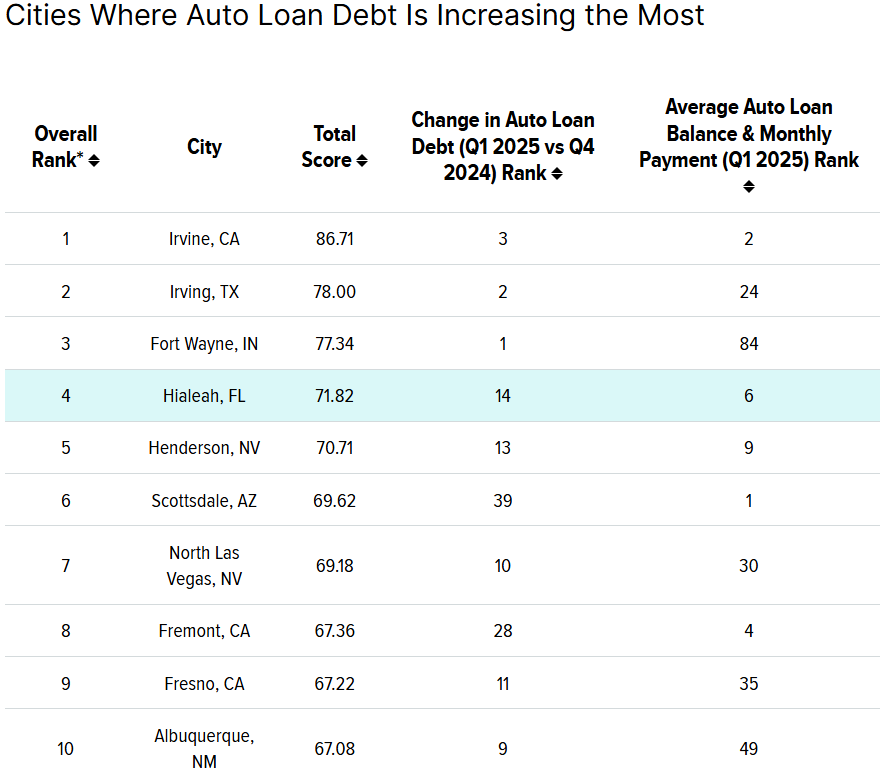
Auto Loan Debt Rising in the U.S. – Here are Cities with the Most

People in the U.S. collectively owe over $1.64 trillion in auto loan debt, with the average household owing nearly $14,000. These loans have become significantly more expensive, and interest rates have surged.

WalletHub has identified the cities where auto loan debt is growing the fastest and those where the increases are more modest by examining proprietary consumer debt data.  Here are the findings:

Cities with the Most Auto Loan Debt

Hialeah ranks in the Top 5 cities where auto loan debt is increasing the most. Miami comes in at #43 on the list. In most of the Top 10 cities on the list, this extra debt is a bad sign because those cities tend to have high debt delinquency rates and a lot of people experiencing financial distress.

Click here to read more.

If you have questions on this topic or are in a financial crisis and considering filing for bankruptcy, contact an experienced Miami bankruptcy attorney who can advise you of all of your options. As an experienced CPA as well as a proven bankruptcy lawyer, Timothy Kingcade knows how to help clients take full advantage of the bankruptcy laws to protect their assets and get successful results. Since 1996 Kingcade Garcia McMaken has been helping people from all walks of life build a better tomorrow. Our attorneys’ help thousands of people every year take advantage of their rights under bankruptcy protection to restart, rebuild and recover. The day you hire our firm, we will contact your creditors to stop the harassment. You can also find useful consumer information on the Kingcade Garcia McMaken website at www.miamibankruptcy.com.
Medical Debt

New Federal Rule Removes Medical Debt from 15 million Americans’ Credit Reports

The Consumer Financial Protection Bureau (CFPB) finalized a rule that will remove medical debt from credit reports and prohibit lenders from using medical information in their approval decisions.

The CFPB estimates the change will remove $49 billion in medical bills from the credit reports of about 15 million Americans. Consumers with medical debt on their record could see their credit score rise by an average of 20 points because of the rule change, and approximately 22,000 more mortgages will be approved each year.

Even with health insurance, there are deductibles and copays the patient is responsible for. In addition, your policy may have a coverage limit or not pay for certain treatments.

After the insurance company pays its share, the patient is responsible for the remainder. Medical debt can come from a variety of sources, including:

  • Hospital visits
  • Surgeries
  • Doctor and dentist appointments
  • Prescriptions
  • Ambulance companies

How Medical Debt is Handled in Bankruptcy

In bankruptcy, medical debt is treated the same as credit card debt. Medical bills are listed as general unsecured debt and can be easily wiped out in a Chapter 7 bankruptcy filing.  Making the decision to file for bankruptcy is never an easy one.

Fortunately, consumers have the option available to them to file for bankruptcy to escape this burden of medical debt. In a bankruptcy case, debts are classified into two categories: secured and unsecured, as well as priority and nonpriority debts. Secured debts are those that are backed by a form of collateral, while priority debts can be unsecured but receive special status, such as tax bills, student loans, and child support. Unsecured debts are those debts that are not secured by collateral and include personal loans, credit card debt, and medical debt.

In a bankruptcy case, unsecured debts are the ones that are discharged at the end of the case, while priority and secured debts are the focus of payment plans or payment in a Chapter 7 case after assets are liquidated. If a debt is discharged, this means the court has issued an order stating that the debt does not have to be paid.

Medical debt may also become part of the repayment plan issued as part of a Chapter 13 bankruptcy case. The bills may not end up paid in full, but the medical providers will receive at least some amount of payment, which helps the consumer maintain a relationship with their healthcare providers. Repayment plans normally last three to five years, ending with the consumer’s remaining debts, including medical debt, getting discharged.

Those who have experienced illness or injury and found themselves overwhelmed with medical debt should contact an experienced Miami bankruptcy attorney. In bankruptcy, medical bills are considered general unsecured debts just like credit cards. This means that medical bills do not receive priority treatment and can easily be discharged in bankruptcy. Bankruptcy laws were created to help people resolve overwhelming debt and gain a fresh financial start. Bankruptcy attorney Timothy Kingcade knows how to help clients take full advantage of bankruptcy laws to protect their assets and get successful results. Since 1996 Kingcade Garcia McMaken, P.A., has been helping people from all walks of life build a better tomorrow. Our attorneys’ help thousands of people every year take advantage of their rights under bankruptcy protection to restart, rebuild and recover. The day you hire our firm; we will contact your creditors to stop the harassment. You can also find useful consumer information on the Kingcade Garcia McMaken, P.A. website at www.miamibankruptcy.com.

SOURCE: New Federal Rule Removes Medical Debt from Credit Reports (CNBC)

Chapter 7 Bankruptcy, Means Test

How Do I Know If I Qualify for Chapter 7 Bankruptcy?

Federal bankruptcy law dictates the eligibility requirements to file Chapter 7 bankruptcy. The biggest of these requirements is the means test, which compares the filer’s income to his or her debt. The means test is a two-step process. The first step requires looking at the consumer’s income as compared to Florida’s average income. If the filer’s income is higher than the median income for a household in Florida, the filer will need to then take the second part of the means test.

The second part of the means test requires the filer to submit documentation regarding his or her allowable expenses over the past six months. These expenses can include rent, groceries, medical costs, and clothing. After subtracting all these expenses, any money left is referred to as disposable income. If the individual does not have enough disposable income to pay for remaining debts, he or she qualifies under the means test.

It’s important to remember that Chapter 7 bankruptcy isn’t just for low-income filers. You can earn significant monthly income and qualify for Chapter 7 bankruptcy if you have a large family or considerable expenses, like a high mortgage, car loan payments, taxes, and other reasonable expenses.

A bankruptcy case has no minimum or maximum requirement when it comes to unsecured debt for Chapter 7 bankruptcy. So long as the filer qualifies through the means test, how much debt he or she carries should not affect that person’s ability to successfully file for Chapter 7.

Click here to read more.

If you have questions on this topic or are in financial crisis and considering filing for bankruptcy, contact an experienced Miami bankruptcy attorney who can advise you of all of your options. As an experienced CPA as well as a proven bankruptcy lawyer, Timothy Kingcade knows how to help clients take full advantage of the bankruptcy laws to protect their assets and get successful results. Since 1996 Kingcade Garcia McMaken has been helping people from all walks of life build a better tomorrow. Our attorneys’ help thousands of people every year take advantage of their rights under bankruptcy protection to restart, rebuild and recover. The day you hire our firm, we will contact your creditors to stop the harassment. You can also find useful consumer information on the Kingcade Garcia McMaken website at www.miamibankruptcy.com.

Consumer Bankruptcy, Debt Relief

When Bankruptcy Is the Best Option

One of the biggest advantages of filing bankruptcy is the possibility of a fresh financial start. Filing for bankruptcy also stops collection calls, wage garnishments, and lawsuits. Chapter 7 bankruptcy wipes out many kinds of debt, including: credit card debt, medical bills, personal loans, civil judgments, past-due rent and utility bills, business debts and some older tax debts.

Filing for bankruptcy may make sense depending on how much debt you have, your other financial obligations, and other methods of debt relief you have tried.

To file Chapter 7 bankruptcy, you will need to complete and submit paperwork outlining your earnings, spending, and amount of debt to the bankruptcy court. Those that are employed will also be required to share tax returns and pay stubs.

Typically, those that file should meet the following criteria:

  • Have a low credit score
  • Have no foreseeable way to pay off debt within the next few years
  • Do not possess expensive property
  • Have more than $10,000 in debt
  • Struggle to make payments
  • Are in fear of legal action being taken against them due to debt.

A qualified bankruptcy attorney can offer guidance and answer any questions the person may have about whether it is time to move forward and proceed with a bankruptcy filing. A bankruptcy attorney can also assist in determining which type of bankruptcy is best.  

If you have questions on this topic or are in financial crisis and considering filing for bankruptcy, contact an experienced Miami bankruptcy attorney who can advise you of all of your options. As an experienced CPA as well as a proven bankruptcy lawyer, Timothy Kingcade knows how to help clients take full advantage of the bankruptcy laws to protect their assets and get successful results. Since 1996 Kingcade Garcia McMaken has been helping people from all walks of life build a better tomorrow. Our attorneys help thousands of people every year take advantage of their rights under bankruptcy protection to restart, rebuild and recover. The day you hire our firm, we will contact your creditors to stop the harassment. You can also find useful consumer information on the Kingcade Garcia McMaken website at www.miamibankruptcy.com.
SOURCE: https://www.nerdwallet.com/article/finance/bankruptcy-best-option

Credit Card Debt

Credit Card Debt Among Retirees Jumps

While credit card interest rates are at an all-time high, the amount of retirees with credit card debt has increased substantially.

About 68% of retirees had outstanding credit card debt in 2024, up from 40% in 2022 and 43% in 2020, according to a new poll by the Employee Benefit Research Institute.

This is a worrisome financial trend, since many retirees are on a fixed income. About 2 in 5 cardholders have maxed out or nearly hit their card limit since early 2022, resulting from inflation and higher interest rates, according to a recent Bankrate poll.

There are a few ways retirees can get their credit card debt under control.

  1. Reduce expenses
  2. Boost income
  3. Reduce your interest rate

As bankruptcy attorneys, we see credit card debt as one of the most common problems facing those with serious financial challenges.

Filing for bankruptcy is a viable option for those struggling with insurmountable credit card debt. Chapter 7 is the fastest form of consumer bankruptcy and forgives most unsecured debts like credit card debt, medical bills, and personal loans.  There are certain qualifications a consumer must meet in regard to income, assets, and expenses to file for Chapter 7 bankruptcy, which is determined by the bankruptcy means test.

Please click here to read more.

If you have questions on this topic or are in financial crisis and considering filing for bankruptcy, contact an experienced Miami bankruptcy attorney who can advise you of all of your options. As an experienced CPA as well as a proven bankruptcy lawyer, Timothy Kingcade knows how to help clients take full advantage of the bankruptcy laws to protect their assets and get successful results. Since 1996 Kingcade Garcia McMaken has been helping people from all walks of life build a better tomorrow. Our attorneys help thousands of people every year take advantage of their rights under bankruptcy protection to restart, rebuild and recover. The day you hire our firm, we will contact your creditors to stop the harassment. You can also find useful consumer information on the Kingcade Garcia McMaken website at www.miamibankruptcy.com.

Car Repossession, Florida Bankruptcy Exemptions

Do I Have to Surrender My Car in Bankruptcy?

Filing for Chapter 7 bankruptcy can clear most unsecured debts, but it may also require selling or giving up some assets to pay debts. A fair question and one many people have is: “Will I be able to keep my vehicle if I file for bankruptcy?”

The answer is yes. Most filers will be able to keep their vehicle after filing for bankruptcy. Florida bankruptcy laws offer generous exemptions which allow individuals to keep various types of property, including their vehicle.  Vehicles are often exempt if they are necessary for you to maintain a job and household.

In a Chapter 7 bankruptcy, if your car is financed, you can surrender it by returning it to the lender. With that, the loan will be discharged in bankruptcy but will leave you without a car.

If you file Chapter 7 bankruptcy and are current on payments, you can keep the car if your equity is protected under state law. Under the Florida Motor Vehicle Exemption, bankruptcy filers can exempt up to $1,000 in motor vehicle equity. This amount can be even more if a married couple is filing for bankruptcy jointly. In cases where you are keeping a car with a loan on it, make sure you continue to stay current on your payments. The lender can still assert its lien rights if you get behind on payments and you could lose your car.

Secured Loans

It helps to understand the nature of a car loan as compared to other debt in a bankruptcy case. Since a car loan is attached to an asset, this debt is labeled as a secured debt, which means the asset can be used to pay off the amount owed if the consumer cannot continue paying. This debt is not liquidated in a Chapter 7 case if the consumer wishes to keep the car after everything is over. Therefore, the filer must file Form 108 at the start of the case, which is known as a statement of intention. This form tells the court whether the consumer wishes to reaffirm the car loan, redeem the car, or surrender it. This statement of intention must be filed within 30 days of the bankruptcy case being filed, or the car loan is not considered part of the bankruptcy proceeding.

Status of Vehicle

Determining the status of the filer’s vehicle is important before determining if he or she can keep the car. The status can be either the person owns it free and clear, he or she is leasing the car, or the person is still paying a loan on the car. If the filer is still making monthly payments on a loan, the lender holds the title to the car as collateral. Once the car loan is paid in full, the title then shifts to the vehicle owner. If, during the loan payments, the filer cannot keep up with payments, the lender will then take the car back, which is also known as repossession.

Being current on the car loan’s payments is key in both Chapter 7 and Chapter 13 in terms of the ability to keep the filer’s car. It makes it more likely that the filer will be able to continue paying on the car even after the bankruptcy case is over.

Value of the Car

The value of the vehicle is also important in how it is treated in bankruptcy. In a bankruptcy case, the value of the car is determined by the actual cash value of the vehicle. This value is usually the retail replacement value of the car. The car’s make and model, mileage, and condition determine the actual cash value of the car. Equity is important, as well, which is determined by subtracting what the filer owes on the car from its current value.

Bankruptcy Exemptions

Equity is key when it comes to determining the exemption that allows the filer to keep the car. Florida has one of the most generous bankruptcy exemptions in the country. To use Florida’s exemptions, the filer must have resided in Florida for at least 730 days before filing his or her bankruptcy petition. To claim the full value of the homestead exemption in Florida, the filer must have owned the property for at least 1,215 days before the bankruptcy filing. Under Florida bankruptcy exemptions, the filer can exempt up to $1,000 in motor vehicle equity or more if the person is married and filing for bankruptcy jointly.

Redeeming the Car

In a Chapter 7 case, the filer may be able to keep the car by redeeming its current replacement value. To do this, the filer pays to the lender what is owed on the car, minus the car’s current replacement value to own the car outright. Unfortunately, not many filers are able to do this since most do not have this kind of money available, which is why fewer than two percent (2%) of all filers redeem their car.

Reaffirmation Agreement

The filer can also keep the car by reaffirming the debt. This means he or she will agree to a new payment plan with the lender. To reaffirm the debt, the filer must submit Form 108, which is a statement of intent. Approximately two-thirds of all filers take this route.

Surrendering the Vehicle

If the filer cannot pay the debt in full or is not able to feasibly reaffirm the debt, he or she may surrender the car. Filers normally surrender their vehicles when they are significantly behind on payments. When a surrender happens, the lender gets the car back and the debt owed on it is forgiven. Unlike a repossession, the consumer is no longer liable for the deficiency balance owed on the car, which is what occurs in a repossession when the lender resells the car for less than what is still owed on it.

Chapter 13 Bankruptcy

The above options are normally the choices available to consumers in a Chapter 7 bankruptcy case. However, if the consumer wishes to keep his or her car, Chapter 13 bankruptcy is usually the best route for him or her. In a Chapter 13 case, the consumer works with the bankruptcy trustee to create a repayment plan that takes three to five years to complete where he or she pays down debts over the course of the case, liquidating whatever is left at the end of this period.

If the consumer has a lot of equity in the vehicle and if he or she can pay past due payments while remaining current on all other payments, it is likely he or she will be able to keep the car in a Chapter 13 case.

Many times, the bankruptcy court can also get the lender to reduce the interest rate on a vehicle loan under Chapter 13. This reduction will lower the person’s monthly payments and will make it easier for him or her to make payments.

Additionally, in a Chapter 13 case, if the consumer has owned the car for more than 910 days, which is roughly about two and a half years, the bankruptcy court can rule that the loan balance owed will be based on what the car is worth now as opposed to what the balance of the original loan is.

If you have questions on this topic or are in financial crisis and considering filing for bankruptcy, contact an experienced Miami bankruptcy attorney who can advise you of all of your options. As an experienced CPA as well as a proven bankruptcy lawyer, Timothy Kingcade knows how to help clients take full advantage of the bankruptcy laws to protect their assets and get successful results. Since 1996 Kingcade Garcia McMaken has been helping people from all walks of life build a better tomorrow. Our attorneys help thousands of people every year take advantage of their rights under bankruptcy protection to restart, rebuild and recover. The day you hire our firm, we will contact your creditors to stop the harassment. You can also find useful consumer information on the Kingcade Garcia McMaken website at www.miamibankruptcy.com.
Sources:

If I File Bankruptcy, Can I Keep My Car? (debt.org)

What Happens to My Car During Bankruptcy? – Experian