Lawyers in the News, Legal Awards

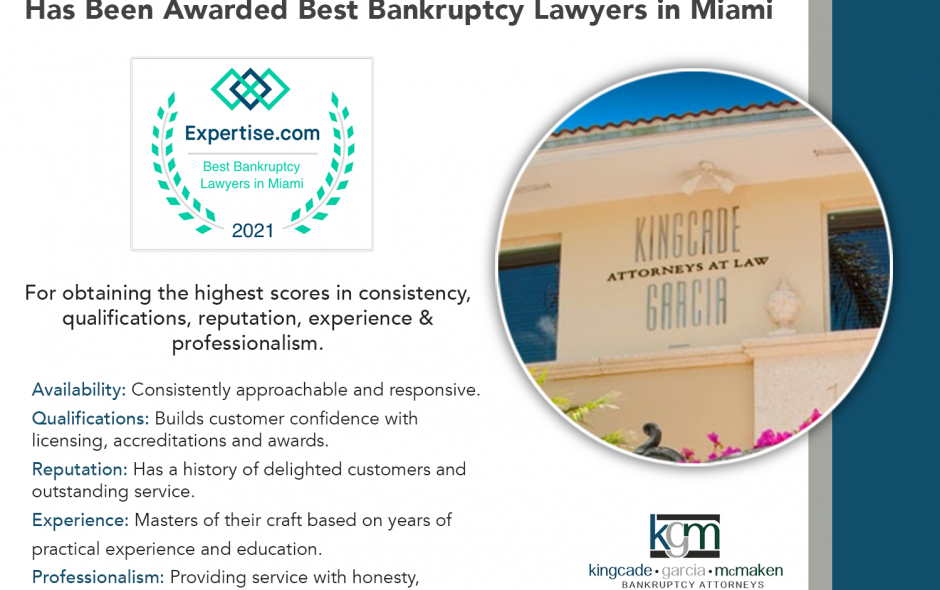
Kingcade Garcia McMaken Awarded ‘Best Bankruptcy Lawyers in Miami’ for 2021

The Miami-based bankruptcy law firm of Kingcade Garcia McMaken has been awarded one of the ‘Best Bankruptcy Lawyers in Miami’ for 2021, by Expertise for obtaining the highest scores in consistency, qualifications, reputation, experience & professionalism.

“We are extremely honored to have received this award,” says Founding Partner and Managing Shareholder, Timothy S. Kingcade. “In today’s competitive legal environment, clients have an increasing number of options when choosing an attorney. It is important that clients and potential clients know how serious we take quality customer service and business ethics. This is a true testament to the commitment we have to our clients and the standards we uphold as a law firm.”

COVID-19, Foreclosure Defense, Foreclosures

Emergency Mortgage Relief Could Extend Through 2022

Since the start of the COVID-19 pandemic, millions of homeowners have benefited from the mortgage relief programs offered by the federal government, and some private lenders.  Now that a year has passed, approximately 2.5 million homeowners are still enrolled in some sort of mortgage relief program, whether it be payment suspension or mortgage forbearance, according to the Mortgage Bankers Association (MBA) 

It is for this reason that the Consumer Financial Protection Bureau (CFPB) wants to extend these provisions and programs further into the future to ensure that these homeowners are not forced into foreclosure.  

Bankruptcy Law

Knowing When to File for Bankruptcy

Making the decision to file for bankruptcy is never an easy one. Many times, it can be difficult to know when the time is right or when it is better to wait.  

A bankruptcy case allows a consumer to receive a much-needed financial fresh start by discharging his or her outstanding consumer debts. The types of debts that are discharged in a bankruptcy case include credit card debt, mortgages, car loans, medical debt, and other unsecured loans.  

Bankruptcy Law

What is a ‘No Asset’ Chapter 7 Bankruptcy Case?

In a no-asset Chapter 7 bankruptcy case, the person filing for bankruptcy keeps all of their property because it falls within the exemptions provided under federal law or the law in their state.

With a Chapter 7 liquidation bankruptcy, a filer surrenders their assets to the bankruptcy estate, which uses them to pay off creditors. But in reality, this is only true of non-exempt property. Many of our cases, are in fact, ‘no asset’ cases. Bankruptcy law recognizes that filers need to retain some property so they can survive the process with something on which to build a future after bankruptcy.

Bankruptcy Law

The Pre-Bankruptcy Credit Counseling Requirement and What Filers Need to Know

All bankruptcy filers are required to take and complete two educational courses before receiving a final bankruptcy discharge. These courses are required for both Chapter 7 and Chapter 13 filers. It is important that individuals considering bankruptcy be aware of these requirements for their cases to be successful.  

At the start of a bankruptcy case, the individual filing must meet certain requirements. The filer must disclose his or her complete financial picture by submitting required bankruptcy financial declarations. He or she must also pay a filing fee, request a fee waiver, or request an installment payment for the fee. Lastly, the individual must submit proof that he or she received credit counseling from an agency approved by the U.S. Trustee’s office. This proof of completion must show that the course was taken within 180 days prior to filing.

student loan debt, Student Loans

Debt Cancellation for Disabled Borrowers Reinstated by the Department of Education

The U.S. Department of Education announced recently that they will cancel federal student loan debt for borrowers who are no longer able to work due to disabilities. This announcement affects tens of thousands of borrowers currently paying on outstanding federal student loan balances.   

Student loan advocates say that this small step is the first of many to help reform the student lending system, including opening debt forgiveness to groups who are legally entitled to receive it but have not yet received debt forgiveness.  

student loan debt, Student Loans

Student Debt Cancellation Bill Scheduled to be Signed into Law this Week

Congress has passed a $1.9 trillion stimulus package that includes important provisions concerning student loan cancellation, as well as increased federal regulations on for-profit colleges.   

Several different objectives were met by Congressional leaders through the passing of this legislation. One of the biggest goals was to address the tax burden that student loan borrowers face when receiving any portion of their student loan debt forgiven. Up until now, whenever a borrower received forgiveness for any portion of his or her student loan debt, the amount that was forgiven was considered taxable income. Under this legislation, tax forgiveness will be treated as tax free for the next several years.  

Bankruptcy Law, Business Bankruptcy

The Impact the Coronavirus has had on Bankruptcy Filings in Miami Beach

The economic impact caused by the coronavirus (COVID-19) pandemic has been substantial throughout the country, and Miami Beach is not excluded. Countless businesses have been forced to close temporarily and many even permanently. While technically the number of bankruptcies were down at the end of 2020 nationwide, financial experts fear that the number of bankruptcy filings will increase over the next several years.  

While the number of consumer bankruptcies were down nationwide, the number of Chapter 11 business bankruptcies saw an increase of 18.7 percent when compared to 2019. This form of bankruptcy is normally used by businesses that hope to stay in operation through the Chapter 11 bankruptcy process that allows them to renegotiate their debts. Several larger businesses, including Neiman Marcus and J.C. Penney filed for Chapter 11 in 2020.  

Specifically, in Florida, a total of 37,776 bankruptcies were filed in 2020, which is 19.26 percent lower than the 46,786 filed in 2019. Of all the bankruptcy cases filed in 2020, businesses accounted for four percent of these cases. This number may seem small, but business bankruptcies tend to have a significant effect far past the bankruptcy case alone, including the effect these closures and filings have on the individual employees who lost their job as a result.  

Many times, a ripple effect can be seen on other businesses after one or more close.  

According to figures from the U.S. Courts Administrative Office, a total of 7,430 bankruptcies were filed in Miami-Dade County in 2020. This figure is slightly less than the 8,705 filed in 2019.  

While consumer bankruptcies were down in Miami-Dade County, the number of business bankruptcies saw a slight increase. It is reported that 322 Miami area business bankruptcies were filed in 2020, as compared to 215 filed in 2019. Of these cases filed in 2020, 188 of them were filed under Chapter 7, commonly referred to as a liquidation bankruptcy. Only 129 Chapter 7 business cases were filed in 2019.  

Miami-Dade County did see an increase in the number of Chapter 11 bankruptcy case filed in 2020. Approximately 120 were filed in 2020, as compared to the 62 filed in 2019.  

Individual consumer bankruptcies in Miami-Dade County did not see the same increase, however. According to court filings, a total of 7,108 non-business consumer bankruptcy cases were filed in 2020, as compared to the 8,490 filed in 2019. Of these cases, 4,841 were Chapter 7 filings and 2,260 were Chapter 13 filings. In comparison, 5,067 Chapter 7 cases were filed while 3,414 Chapter 13 cases were filed in 2019.  

Despite the decrease between 2019 and 2020, financial experts predict these numbers will continue to increase through 2021 and beyond. As the COVID-19 pandemic continues, more and more businesses and individuals will continue to feel the economic impact of this crisis.  

Please click here to read more.  

If you have questions on this topic or are in financial crisis and considering filing for bankruptcy, contact an experienced Miami bankruptcy attorney who can advise you of all of your options. As an experienced CPA as well as a proven bankruptcy lawyer, Timothy Kingcade knows how to help clients take full advantage of the bankruptcy laws to protect their assets and get successful results. Since 1996 Kingcade Garcia McMaken has been helping people from all walks of life build a better tomorrow. Our attorneys’ help thousands of people every year take advantage of their rights under bankruptcy protection to restart, rebuild and recover. The day you hire our firm, we will contact your creditors to stop the harassment. You can also find useful consumer information on the Kingcade Garcia McMaken website at www.miamibankruptcy.com.   
Credit Card Debt, Debt Relief

The Best Way to Conquer Credit Card Debt

Many consumers find themselves still struggling with large amounts of credit card debt. Much of this credit card debt is carried over from previous years. Certain steps can be taken to tackle credit card debt and either pay it off in full or reduce the amount owed to a more reasonable number.   

The first step is to push the pause button on spending and inventory the situation. The consumer’s debt cannot be conquered until the spending stops. It is important to review what has been purchased the past few months, determining how much has been spent and what is owed. It also helps to write down what the interest rate is for each card, noting the balance owed and the minimum monthly payment. Taking this first step will allow the consumer to be able to put together a budget and a plan to pay off the debt over time.  

Once the consumer has a chance to review his or her debt situation, the next step is to select a strategy to pay down the debt. Two of the most common methods include the snowball method and the avalanche method.  

With the snowball method, the consumer arranges his or her credit card balances from smallest to largest balances. The consumer focuses his or her attention on the card with the smallest balance first, paying down as much as possible on that card while continuing to make the minimum monthly payments on the other cards. Once the first card is paid in full, the consumer focuses on the card with the next smallest balance until all cards are paid off in full. The snowball method requires a great deal of patience and discipline, but it can be an effective way to pay down debt. However, this method does involve paying more in interest over time since credit cards with higher balances tend to have higher interest rates. 

The avalanche method works similarly to the snowball method, but the consumer focuses on the credit card with the highest interest rate first. This method allows the consumer to get out of debt quicker than the snowball method since it focuses on the larger balances with the higher interest rates first, but it can be hard to stay motivated with this method since seeing the results of the consumer’s efforts can be harder to immediately see. 

Another method to pay down credit card debt involves consolidating the debt through a personal loan or balance transfer.  Many credit card companies offer balance transfers, allowing the consumer to transfer multiple credit card balances to one card with a zero or low introductory interest rates. It is important that the consumer pay the balance down before that promotional period expires, however. Otherwise, the interest rate can skyrocket at the end of the promotional period, leaving the consumer in a worse position than before. A personal loan can also be used to pay off all the consumer’s credit card balances. This method allows the consumer to focus his or her attention on one, fixed monthly payment over time in lieu of multiple credit card payments.      

Please click here to read more.  

If you have questions on this topic or are in financial crisis and considering filing for bankruptcy, contact an experienced Miami bankruptcy attorney who can advise you of all of your options. As an experienced CPA as well as a proven bankruptcy lawyer, Timothy Kingcade knows how to help clients take full advantage of the bankruptcy laws to protect their assets and get successful results. Since 1996 Kingcade Garcia McMaken has been helping people from all walks of life build a better tomorrow. Our attorneys’ help thousands of people every year take advantage of their rights under bankruptcy protection to restart, rebuild and recover. The day you hire our firm, we will contact your creditors to stop the harassment. You can also find useful consumer information on the Kingcade Garcia McMaken website at www.miamibankruptcy.com.   
COVID-19, student loan debt

New PPP Loan Rules Make It Easier for Student Loan Borrowers to Obtain Funds

New rules with respect to who can receive financial assistance through the Paycheck Protection Program (PPP) will open the door for struggling student loan borrowers who have previously been unable to qualify for the PPP loan program. These new regulations took effect on March 1, 2021.  

The funds received through the PPP were meant to offer financial assistance to struggling businesses, allowing them to stay in operation during the COVID-19 pandemic. For the most part, these loans are forgiven later. Previously, any business that was owned 20 percent or more by an individual who had defaulted on his or her student loan payments was considered ineligible for PPP loan assistance. This rule clearly shut out a large group of individuals and businesses who arguably could use the governmental assistance.  

The Biden administration has changed this rule, effective March 1, 2021. A default or delinquency on student loan payments will not automatically disqualify a PPP loan applicant. This change comes along with several others, including priority access for businesses employing 20 or fewer individuals.  

Over the past several years, student loan debt has surpassed credit card and auto debt with over 42 million Americans carrying some amount of student loan debt. Of this number, approximately one-third of them are in either delinquency or default on these loans.  

According to a report by the Center for Responsible Lending, a large number of these borrowers are self-employed. Approximately 800,000 self-employed Americans are reportedly behind on their student loan payments. Additionally, 500,000 minorities have also be excluded from PPP assistance due to the status of their student loans.   Student loan reform advocates have praised this change, saying that small business owners have been bearing the brunt of the financial struggles suffered during the COVID pandemic.

Please click here to read more.  

For borrowers who are struggling with student loan debt, relief options are available.  Many student loan borrowers are unaware that they have rights and repayment options available to them, such as postponement of loan payments, reduction of payments or even a complete discharge of the debt. There are ways to file for bankruptcy with student loan debt.  It is important you contact an experienced Miami bankruptcy attorney who can advise you of all your options. As an experienced CPA as well as a proven bankruptcy lawyer, Timothy Kingcade knows how to help clients take full advantage of the bankruptcy laws to protect their assets and get successful results. Since 1996 Kingcade Garcia McMaken has been helping people from all walks of life build a better tomorrow. Our attorneys help thousands of people every year take advantage of their rights under bankruptcy protection to restart, rebuild and recover. The day you hire our firm, we will contact your creditors to stop the harassment. You can also find useful consumer information on the Kingcade Garcia McMaken website at www.miamibankruptcy.com.