
Florida Super Lawyers

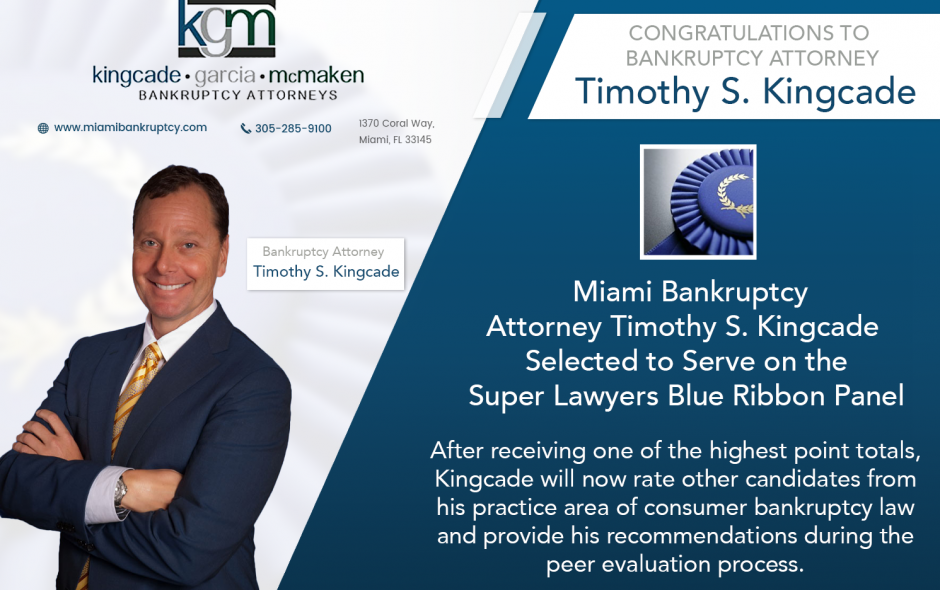
Miami Bankruptcy Attorney Timothy S. Kingcade Selected to Serve on the Super Lawyers Blue Ribbon Panel

Managing Shareholder, Timothy S. Kingcade of the Miami-based bankruptcy and foreclosure defense law firm of Kingcade Garcia McMaken has been selected as a Blue Ribbon Panelist for Florida Super Lawyers. Only those in each practice area with the highest point totals are asked as part of the panel to evaluate the candidacy of fellow lawyers to enter the prestigious Super Lawyer rankings.

“It is an honor to be selected among the Blue Ribbon Panelists in the most comprehensive and independent review of exceptional lawyers. Being selected as a Super Lawyer the past seven years is an achievement in and of itself, but to know that Super Lawyers values my opinion in the evaluation of my peers receiving the title of Super Lawyer is a true privilege I graciously accept,” said Timothy S. Kingcade.

Credit Card Debt

How to Negotiate Your Credit Card Debt

When someone owes a large amount of money on credit cards, the possibility of ever paying down that balance can seem impossible. Simply making the minimum monthly payments can be a struggle, as well, especially during the current pandemic. However, credit card companies would rather work with the consumer directly in lieu of the account going into default, forcing them to pursue a collection on the amount owed. It is possible to negotiate directly with the credit card company on the amount owed in certain circumstances.  

During the coronavirus (COVID-19) crisis, certain credit card companies are working with consumers who are behind on payment. This assistance is temporary in nature but can include pausing payments, reducing interest rates, waving late fees, and putting a pause on interest charges.  

Bankruptcy Law

The Fear of Bankruptcy is What Keeps Many Consumers from Filing

The fear of the unknown is a powerful force. Unfortunately, the fear of filing for bankruptcy and the unknown keeps many from proceeding with a bankruptcy case, even when it is the best option.

It is for this reason that only a small portion of American consumers file for bankruptcy annually, even though many of them could benefit from either a Chapter 7 or Chapter 13 bankruptcy filing. While many different reasons exist for this failure to file, a misunderstanding of the process and fear of taking that first step keeps them from moving forward.    

student loan debt, Student Loans

ITT Tech Student Loan Lender Must Pay $330 Million in Debt Relief to Former Students

An agreement has been reached between the attorneys general from 43 states and the now-closed ITT Technical Institute (ITT Tech). This agreement was part of a lawsuit brought by former ITT Tech students, requesting approximately $330 million in student loan forgiveness for 43,000 loans.

This lawsuit was a joint legal effort brought on by the Consumer Financial Protection Bureau (CFPB) and 43 different states. The settlement was made with PEAKS Trust, a private lending institution that is run by ITT and is also affiliated with several Deutsche Bank entities.

Coronavirus, COVID-19, Foreclosure Defense, Foreclosures

Covid-19 Mortgage Bailouts Decline, New Foreclosure Crisis Looming

Homeowners are struggling to keep up with their mortgage payments as the coronavirus (COVID-19) crisis continues. The mortgage bailouts offered by the federal government and private sector during the crisis have helped temporarily, but as the number of bailouts begin to decline, many homeowners are finding themselves facing the possibility of impending foreclosure.

According to figures from Black Knight, a mortgage technology and data firm, approximately 3.7 million borrowers are still receiving assistance through federal government and private sector mortgage forbearance programs.  This figure represents nearly seven percent of all active mortgages. Forbearance plans allow borrowers to temporarily delay monthly payments for anywhere between three months to a year.

Debt Collection, Debt Relief

How to Work with Debt Collectors When You Are Not Able to Pay

Dealing with debt collectors is stressful, especially when the person owing the debt simply does not have the financial resources to pay. It can be easy to fall behind on bills, and before too long, the consumer will find himself or herself juggling countless collection calls. These calls are not always pleasant. After all, the debt collectors have one job to do and that job is to receive payment on the debt. What is the best way to deal with debt collectors when an individual is not able to come up with the payment?

Stay Calm and Attempt to Work with the Collector

Debt collectors have a reputation of being aggressive when performing their jobs. However, it is important to stay as calm as possible when communicating with a debt collector. If a consumer agrees that he or she owes the debt and does not have the resources to do so, it may still be beneficial to at least attempt to work with the debt collector on paying on the debt. If the person does not have the money but still wants to pay, the collector may mark the consumer down as “refused to pay.” However, do not fear this label. It is essentially meaningless in the collection process. It does not make the collection case against consumer any worse or any better.

Foreclosure Defense, Foreclosures

Tax Implications Homeowners Facing Foreclosure Encounter from the CARES Act

The coronavirus (COVID-19) pandemic has thrown countless Americans into a financial tailspin. Many consumers were pushed out of jobs and put into the position where they are not able to pay the most basic of living expenses, including mortgage payments, to stay in their homes. As the pandemic continues, these homeowners are now put in a terrifying position, facing the real possibility that they could lose their homes.

At the start of the pandemic, lawmakers worked hard to try to keep Americans from facing this possibility by passing the CARES Act. One major part of this stimulus package was the ability for borrowers who carried federally backed mortgages to request a forbearance for up to 180 days on their loan obligations. The hope was this measure would give distressed homeowners breathing room and a chance to stay in their homes during this time of financial difficulty. If needed, borrowers could then request an additional 180 days of relief.

Debt Collection

Facing Debt Collection? Know Your Rights.

When someone is facing debt collection, it is important that person knows his or her rights.  The Fair Debt Collection Practices Act (FDCPA) is a federal law that protects consumers against unfair collection practices, including:

  • Calling you repeatedly to annoy or harass you;
  • Trying to collect more than you owe;
  • Failing to send a written notice of the debt;
  • Threatening violence, using profanity or offensive language;
  • Threatening dire consequences (i.e. – lawsuits, criminal prosecution, wage garnishment, jail time, permanently ruining your credit);
  • Calling you before 8 a.m. or after 9 p.m.;
  • Revealing debt to third parties (i.e. – family, neighbors, friends, co-workers, etc.);
  • Contacting you at your work, after you have requested them to stop;
  • Failing to verify disputed debts;
  • Ignoring cease communication requests.
Credit Card Debt

What Happens to Credit Card Debt When a Person Dies?

After an individual dies, one of the big questions that comes up from those handling the estate of the deceased is what happens to that person’s debt? These debts can include medical bills, taxes, and credit card debt. One of the main concerns brought up by clients is whether they will be personally responsible for the credit card debt of their deceased relative. The good news is only the estate will be responsible for any outstanding debt and not the family of the deceased.

Whether the person has a will or no will, his or her estate will need to be processed through probate court. If the deceased had a will, he or she will have named a personal representative who will handle the estate, and if the person has no will, the court will appoint someone to administer the estate.